Minnesota Stopped Counting in 2008. It’s Time to Start Again.

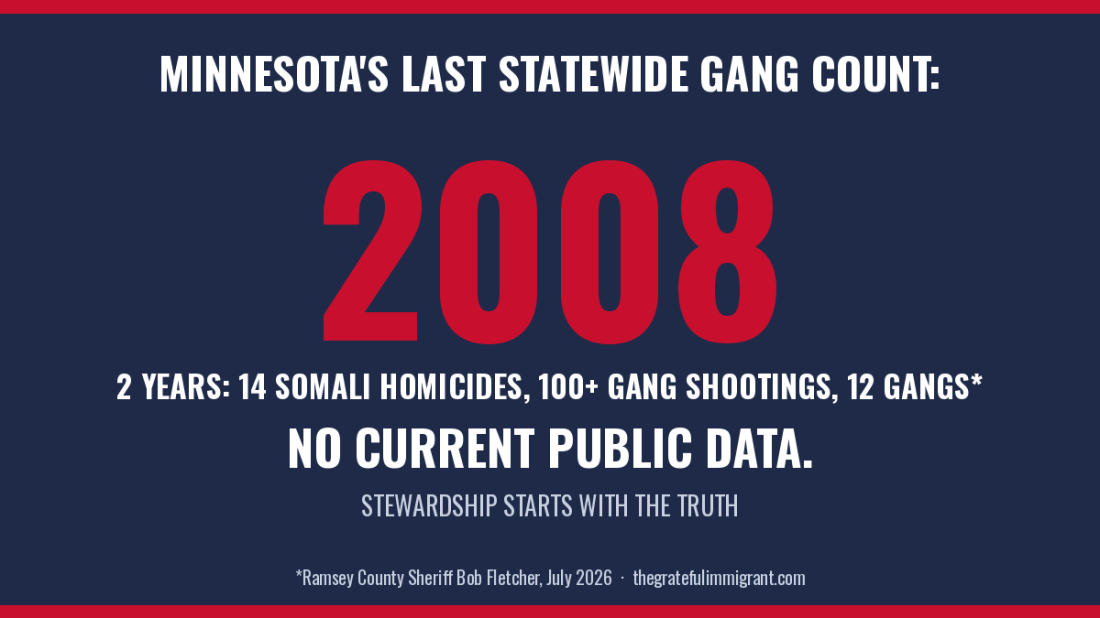
Minnesota stopped counting in 2008

Last Friday night, shots rang out at a high school homecoming game in Eden Prairie. Two young men were wounded. Police say the shooting appears to have been targeted, and no arrests have been made.

Ten days earlier, on September 22, someone fired from a car at teenagers playing basketball outside a church in Edina. By the grace of God, no one was hurt. Afterward, Edina Police Chief Todd Milburn said this on the record:

“For the second time in recent months, Somali teens and young adults have been the targets of or have had some level of responsibility for shootings in community gathering places.”

He called it “consistent with a pattern of gang violence throughout the region.”
https://patch.com/minnesota/edina/somali-teens-young-adults-tied-2nd-edina-shooting-2-months-police-chief-says

In July, Ramsey County Sheriff Bob Fletcher said there had been 14 Somali homicides and more than 100 Somali shootings in two years, all gang-related. His office counts 12 Somali gangs. To his credit, he also said this is about 300 kids, not the whole community.
https://www.cbsnews.com/minnesota/news/ramsey-county-sheriff-somali-gangs/

Here is my concern. The last statewide count of gang members by background in Minnesota was in 2007. Since then, no official number has been published. Nearly twenty years. In that time we’ve seen al-Shabaab recruitment out of the Twin Cities, the Feeding Our Future fraud, with more than $240 million stolen from a program meant to feed children and 66 people convicted, and now shootings at ball games and church courts.
https://www.justice.gov/opa/pr/feeding-our-future-ringleader-sentenced-500-months

We do have numbers on public assistance. In Minnesota, 54 percent of Somali immigrant households receive food stamps, compared with 7 percent of native-born households. 73 percent are on Medicaid, compared with 18 percent.
https://cis.org/Report/Somali-Immigrants-Minnesota

In fairness, about 72 percent of Somali Minnesotans are in the labor force, more than the state average. Many are working hard. Needing help is not the same as committing fraud, and I won’t pretend it is.
https://politifact.com/factchecks/2026/feb/02/donald-trump/bongino-minnesota-somali-employment-poverty-benefi/

But this is the point. We count who gets help. We don’t count who’s doing the harm. You can’t fix what you refuse to measure.

I’m not an expert. I’m an immigrant who loves this state and this country. And I believe coddling is just as harmful as neglect. Looking away to spare feelings doesn’t protect anyone, least of all the young people being pulled into gangs or the families who came here to get away from exactly this kind of violence. They deserve better than our silence.

So here is my call to the officials we entrust with the first job of government, keeping us safe. Our governor, our legislators, our county attorneys, our sheriffs and our police chiefs:

FIERCELY gather the data. Publish it. Then enforce the laws already on the books, without fear and without favor.

That’s stewardship. Not on your knees, but with a spine.

If you’re a Minnesotan, ask your representatives one question: when will we see current, official numbers?

Is it grateful to look away? Or is it grateful to tell the truth and fix it?

Grateful or Ungrateful?

LIVE GRATEFUL 🇺🇸
Gratitude starts in the spine, not on the knees.
— A Grateful Immigrant

Grateful vs. Ungrateful, Episode 1: The Interpreter and the Streamer

Presidents from both parties have told you the same thing.

Barack Obama, 2014: “My fellow Americans, we are and always will be a nation of immigrants.”
Video: https://www.youtube.com/watch?v=6Q_Xk66gsRU&t=828s
Transcript: https://obamawhitehouse.archives.gov/the-press-office/2014/11/20/remarks-president-address-nation-immigration

George W. Bush, 2006: “We’re a nation of laws, and we must enforce our laws. We’re also a nation of immigrants…”
Transcript: https://georgewbush-whitehouse.archives.gov/news/releases/2006/05/20060515-8.html

Hillary Clinton, 2016: “I think we are both a nation of immigrants and we are a nation of laws…”
Video: https://www.youtube.com/watch?v=ANT_ZBhpvtw&t=1439s
Transcript: https://www.presidency.ucsb.edu/documents/presidential-debate-the-university-nevada-las-vegas

Be that as it may, there are two kinds: Grateful and Ungrateful.

This week it comes down to one question. Where does your loyalty sit?

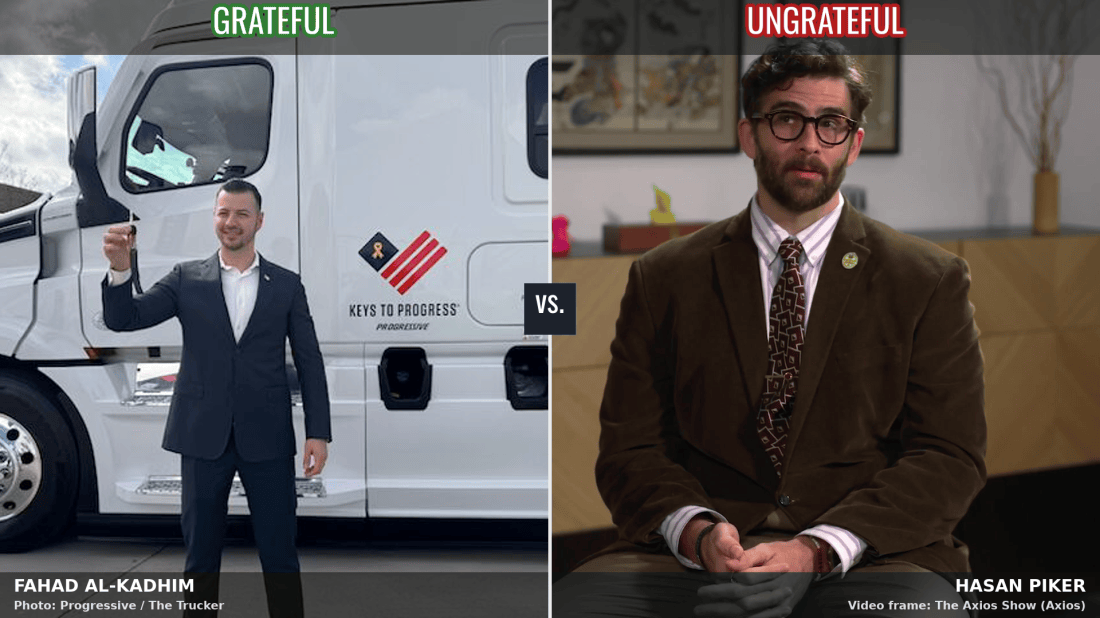
GRATEFUL: FAHAD AL-KADHIM

https://www.abc15.com/news/uplifting-arizona/u-s-military-interpreter-gifted-truck-to-launch-his-own-trucking-company

In 2007, Fahad Al-Kadhim was 17 and living in Iraq. Al-Qaeda grabbed him because his parents worked for the U.S. military. He says they tortured him for three days. His family paid a ransom to get him back.

He had a choice: hide in his room or fight back. He fought back. From 2008 to 2011 he interpreted for U.S. troops in combat. Then he came here, became a citizen, and joined the Army National Guard, where he trained as a truck driver.

On September 17, Progressive’s Keys to Progress program handed him the keys to a 2024 Freightliner, plus $50,000, to start his own trucking company. His plan is to put his girls through college and hire veterans. In his words: “To make sure I pay back to another veteran and keep that culture to support each other.”

He had every reason to stay bitter. He stayed grateful, stayed down to earth, and never got rich off what he went through.

Sources:
ABC15 Arizona: https://www.abc15.com/news/uplifting-arizona/u-s-military-interpreter-gifted-truck-to-launch-his-own-trucking-company
Progressive: https://progressive.mediaroom.com/2026-09-17-U-S-Army-Veteran-to-Receive-2024-Freightliner-Cascadia-Through-Progressives-Keys-to-Progress-R-Program

UNGRATEFUL: HASAN PIKER

Hasan Piker was born in New Jersey. He’s an American citizen with more than 3 million followers on Twitch. On The Axios Show, Alex Thompson asked him straight: “Do you think America then is worse than al-Qaeda?”

His answer: “Pound-for-pound as far as the number of deaths, yes. We have caused tremendous terror all around the world.”

To be fair to him, in the same interview he called 9/11 “a horrifying tragedy” and said, “I truly believe in the promise of America.” Take him at those words too. Then weigh the answer he gave when the question was put to him straight.

That answer isn’t a one-off. In March 2026 he joined the Nuestra America Convoy to Cuba, a trip billed as solidarity with Cuba against U.S. sanctions. In May, Fox News reported that the Treasury Department’s sanctions office sent records requests to about 40 Americans from that trip, Piker and CodePink co-founder Medea Benjamin among them. The question is whether the trip’s money, planning, or supplies broke U.S. sanctions on Cuba. No one has been charged, and Piker says he was never formally served.

On his stream that weekend, he told viewers: “The news is not great, OK? I mean, it’s bullsh*t, but still not great that they’re after your boy.” He said, “Everything we did was cleared by Treasury,” and that he believes the real target is Neville Roy Singham, a pro-communist tech millionaire living in Shanghai who funds CodePink and groups like it.

Here’s the part that matters most. Piker built his career telling millions of people that capitalism is the villain. That same system made him rich. In 2021 he bought a $2.74 million, five-bedroom home in West Hollywood. When people called it hypocritical, his answer was, “Tax the f*** out of people like me.” He sells his own merch. He keeps the lifestyle.

You can believe whatever you want in this country. That’s the whole point of it. But gratitude means living in a way that matches what you say you believe. Take everything the system gives you, then call it the villain from inside the house it paid for. By his own standard, that’s the ungrateful part.

This one doesn’t shout. There’s no flag burning, no rock through a window. It’s calm, it sounds reasonable, and it comes with a body count to back it up. That’s the soft kind of ungrateful, and it reaches more people than the loud kind ever will.

Sources:
Axios interview (video): https://www.youtube.com/watch?v=hBJx9ypjF90&t=1153s
Axios: https://www.axios.com/2026/09/17/hasan-piker-axios-show-terrorism-america
Fox News, Treasury records requests (May 23, 2026): https://www.foxnews.com/politics/feds-subpoena-hasan-piker-medea-benjamin-over-cuba-trips
Newsweek, Piker’s stream response: https://www.newsweek.com/hasan-piker-says-theyre-after-your-boy-as-cuba-trip-investigated-11990078
Just The News, Singham comments: https://justthenews.com/government/federal-agencies/marxist-streamer-hasan-piker-says-scrutiny-over-cuba-trip-about-china
Business Insider, 2021 home purchase: https://www.businessinsider.com/hasan-piker-house-twitch-streamer-criticized-los-angeles-2021-8
The Daily Beast, his reply: https://www.thedailybeast.com/socialist-twitch-streamer-hasan-piker-get-grief-from-twitter-for-buying-dollar3-million-los-angeles-home/

SIDE BY SIDE: THE THREE A’S

Accountability. Do they own their choices, or blame others?
Al-Kadhim: Tortured at 17, he chose to fight back instead of hiding. Now he’s building his own business.
Piker: Blames his own country for “tremendous terror,” and calls the Treasury questions an “intimidation operation.”

Assimilation. Do they become American, or demand America change?
Al-Kadhim: Came here, became a citizen, put on the uniform, learned a trade.
Piker: Born here. He lives the American dream and tells his audience it’s the problem.

Allegiance. This country, or another flag?
Al-Kadhim: Stood with the country al-Qaeda punished his family for helping.
Piker: Said America is worse than al-Qaeda, pound for pound, then went to Havana to stand with Cuba against U.S. sanctions.

GRATEFUL OR UNGRATEFUL?

Cast your verdict in the comments, then send it to someone who needs to see this.

LIVE GRATEFUL 🇺🇸

Gratitude starts in the spine, not on the knees.

— A Grateful Immigrant

Every society has a rhythm.

That rhythm mostly comes from the dominant culture. And for a culture to survive, it has to be good for people. It has to help them flourish. It works best when it’s practiced in the open, with nobody forced into it, and when it expects a lot of each person: show up, own your choices, carry your share.

I used to train couriers. The job was fast, the demand was high, and there was little room for mistakes on efficiency or safety. The first thing I taught every new driver was that every area has a rhythm.

So I’d ask them, “Is Minneapolis different from Duluth?”

Nobody ever said no. Not once. They all knew it. Minneapolis moves one way and Duluth moves another. The traffic, the people, and the pace are all different.

Then I’d say, “Well then, routes have rhythms too. Learn it, and you can do this job at the highest level and enjoy it.”

The ones who learned the rhythm got good. They got fast, safe, and trusted, and they liked coming to work. The ones who fought it were miserable, and they made everyone around them miserable too.

Cultures are the same.

It’s the same lesson and the same comparison. America has a rhythm. You didn’t have to be born here to learn it. Millions of people who weren’t have learned it and done well. But you do have to learn it.

LEARN IT AND LIVE IT.

Presidents from both parties have told us who we are for decades.

Barack Obama, 2014: “My fellow Americans, we are and always will be a nation of immigrants.”
Video: https://www.youtube.com/watch?v=6Q_Xk66gsRU&t=828s
Transcript: https://obamawhitehouse.archives.gov/the-press-office/2014/11/20/remarks-president-address-nation-immigration

George W. Bush, 2006: “We’re a nation of laws, and we must enforce our laws. We’re also a nation of immigrants…”
Transcript: https://georgewbush-whitehouse.archives.gov/news/releases/2006/05/20060515-8.html

Hillary Clinton, 2016: “I think we are both a nation of immigrants and we are a nation of laws…”
Video: https://www.youtube.com/watch?v=ANT_ZBhpvtw&t=1439s
Transcript: https://www.presidency.ucsb.edu/documents/presidential-debate-the-university-nevada-las-vegas

Ronald Reagan, 1984: “We call ourselves a nation of immigrants, and that’s truly what we are.”
Video: https://www.youtube.com/watch?v=CGhP78y8BM8&t=785s

They’re right. We are a nation of immigrants.

But listen to what’s under the words. Bush and Clinton both said it out loud: a nation of immigrants and a nation of laws. That’s the rhythm. Anyone can come, but coming isn’t the end of it. Learning to live here is the part that counts.

Every courier I trained started out new to the route. Being new was never the problem. What mattered was what they did next.

Be that as it may, there are two kinds: Grateful and Ungrateful.

The Grateful learn the rhythm. They learn the language, keep the law, raise their kids to love this place, and leave it better than they found it.

The Ungrateful take everything the rhythm offers and fight it the whole way. They wave another flag, sneer at the house that took them in, and demand it be remade to look like the place they left.

It’s the same doorway, but they walk through it with a different spine.

What to expect

Up to now, I’ve written one post at a time, whenever something needed saying. Starting this week, it’s a weekly series: Grateful vs. Ungrateful.

Every week you’ll get two real stories, one Grateful and one Ungrateful. They’ll be from people of every background and color, because we judge conduct, not where someone came from. Every clip and every story is checked before it goes up. I’ll trace the original source, confirm the date and place, and link it so you can see it for yourself. There’s no rage bait here, only facts.

Then I’ll hold both stories up to the same barometer, the three A’s:

Accountability. Do they own their choices, or blame everyone else?
Assimilation. Do they do the work of becoming American, or demand that America become like the place they left?
Allegiance. Is their loyalty to this country, or to another flag?

Then you judge. Cast your verdict, and send it to someone who needs to see it. Each week I’ll post the results from the week before.

The first verdict comes this week.

Grateful or Ungrateful?

LIVE GRATEFUL 🇺🇸
Gratitude starts in the spine, not on the knees.

— A Grateful Immigrant

Gratitude or Grievance — Which Camp?

Last post I told my Caucasian brothers and sisters to stop apologizing for existing — to say you shall not pass when someone treats their country like a crime they must pay for forever.

This is the other half.

There are two sets of immigrants.

One set brought Gratitude â€” and Agency. The other brought Grievance â€” and entitlement.

Which camp are you in?

Not your passport. Not your accent. How you act.

What those words mean

Gratitude is not soft thank-you notes. You got a country with law, work, speech, and a real shot to stand up. You answer by carrying your share. You treat this place as a country you joined — not a hotel you use and trash.

Agency means you own what happens next. You work. You learn English. You keep your word. You fail and try again. You do not hand your life to a government office or a crowd story about how nothing is your fault.

Grievance means the country owes you first. Your pain is the main fact. History is a bill — and only the people who built this place are supposed to pay it. You can criticize a policy. That is fine. Living as a permanent victim is a job.

Entitlement is grievance with a list. Benefits without duties. Status without joining. The right to change the country while skipping the cost of belonging to it. Soft talk calls that justice. Straight talk calls it demanding without earning.

Remember the three A’s.

Accountability: you own your hands. Assimilation: gratitude with work attached. Allegiance: you defend the country — you do not wear the oath like a costume.

Camp One lives that. Camp Two performs it.

This is not new

History is full of both.

Rome. Some outsiders learned Latin, served in the army, paid taxes, and became Roman in practice. Others came in under deals and kept their own loyalties until the center could not hold. Same empire. Different camps. The split was not “foreign” versus “born here.” It was join versus take.

America’s early settlers and later waves. English, Scots-Irish, Germans, Scandinavians — farms, churches, towns, factories. Then Italians, Irish, Poles, Jews fleeing pogroms and poverty. Many got hated on arrival. A lot of them stayed, learned English, opened businesses, sent kids to school, fought in American wars. That is Camp One while people spat on them. You can see the proof in the cities they built and the names on the war memorials.

Jews in the West after expulsion and murder: often barred, taxed, blamed — and still heavy in science, business, books, and defense of conscience under law. They had every reason to nurse grievance. Many chose work and loyalty to the open countries that finally let them live. Camp Two would have torn down the place that took them in.

East Asians in the United States. Chinese who built railroads under cruel exclusion laws. Japanese farmers before the internment stain. Koreans and Vietnamese after war. Taiwanese and Indians in medicine and engineering. Not a fairy tale. A pattern: arrive, study, open shops, keep family tight, climb. A lot of their home countries were wrecked by war or tyranny. They did not try to remake Main Street into the system they left.

Cubans after Castro. Arrive with almost nothing. Build in Miami. Vote. Argue. Succeed. Hate the dictatorship — and still treat American law as something to join, not something to replace with Castro’s rules. Real anger at a real tyrant. Aimed at the right target. Camp One.

Vietnamese boat people. Risk death at sea. Camps. Then jobs, church, small business, kids with degrees. They did not demand America become communist Saigon. They asked for a chance. Camp One.

People who fled the Soviet bloc. They chose the West knowing what waited at home if they were caught. That choice is a verdict on systems. Agency.

Now the other side.

Camp Two is not “immigrants.” It is a posture. Native-born people do it too.

It shows when people enter — legal or illegal — and treat the law as optional. It shows when the citizenship oath is just paperwork for benefits. It shows when “some people did something” shrugs off the murder of American civilians. It shows when people on the public payroll will not clearly condemn “Death to America.” It shows when needing welfare is sold as a right and self-support is treated as mean. It shows when clan over law, honor violence, religious rule over citizens, or normal corruption get brought in — and you are called a bigot for saying no. It shows when swapping out the host population is called justice, and saying no is called sin. It shows when the West’s habit of criticizing itself becomes a forever debt — while every other people’s empires, slave trades, and mass killings get excused.

Camp Two has older cousins: groups that kept separate rule forever inside a host state; people who used a country as a cash machine; radicals who used free speech to end free speech; outsiders who took wealth and never joined. Different clothes. Same engine: demand without joining.

Lenin, Stalin, Mao, Pol Pot, Kim killed on a scale that still staggers. That was not “Western guilt.” That was a system that claimed every life for the Party. People ran from that toward the West. Camp One was glad to be here. Camp Two showed up and taught the West to apologize for being the place people run to.

The test

Ask yourself out loud.

Do you treat American dead as murdered neighbors — or as a lesson against America? Do you learn English — or demand the country bend around your refusal? Do you work, fail, and try again — or keep a permanent bill for someone else to pay? Do you defend the system that produced this flourishing — Judeo-Christian Western order, constitutional republic, property, speech — or do you call that system the oppression you came here to enjoy? Do you want your kids to join this country — or inherit a grievance business?

If you were born here: same test. Being born here does not put you in Camp One. Soft citizens can be Camp Two with no suitcase. Weak men who will not say you shall not pass are how Camp Two wins without a fight.

If you were born elsewhere, like me: the suitcase does not decide. Your spine does.

I am a grateful immigrant. I am in Camp One — Gratitude with Agency. I did not come to tear down what worked. I came because it worked. I will not help Camp Two turn the host’s fairness into a leash.

Fair friend. Worst enemy when crossed. That line from the last post holds here. Camp One is the friend. Camp Two crossed the line when it mistook patience for permission.

What to do

Keep the door open for Camp One. America needs people who join. Work. Families. Loyalty. That is how you keep a country.

Shut the door on Camp Two’s project. Borders. Vetting. Remove people who break the law. No special deal because the story is sad. A helping hand? Yes. A permanent open tab? Heck no. A right to remake the country you ran toward? Never.

The West is not guilty for being where people want to go. The West is responsible for staying a place worth going to. That takes men who push back, hosts who will not take blame for crimes they did not commit, and immigrants who choose Gratitude with Agency over Grievance with entitlement.

Which camp are you in?

Say it. Then live it.

It starts in the spine, not on your knees.

LIVE GRATEFUL 🇺🇸

– A Grateful Immigrant

You Shall Not Pass

To my Caucasian brothers and sisters:

Stop apologizing for existing.

A sin all races have committed against each other since the beginning of recorded history is being used as a muzzle — aimed mostly at you. Conquest. Slavery. Empire. Tribal slaughter. Every people has blood on the ledger. That is not a Western exclusive. That is the human record.

What is Western — and especially Judeo-Christian in its best fruit — is not the claim that your ancestors were angels. It is the claim that you built something better than the pile of bones: law that cages rulers as well as ruled, conscience that can condemn its own crimes, science, markets, rights that outgrew tribe, a culture that produced the highest human flourishing the world has measured. Food. Medicine. Lifespan. Wealth. Speech. Exit. The chance for a stranger to arrive poor and leave standing.

That is why practically all of the world’s poor who can move — especially from non-Western, non-Judeo-Christian wreckage — try to get into the West. They vote with their feet. They are not lining up for the systems they fled. They are lining up for yours.

A growing number do not stop at entry. They try to replace the populations that built the house and to plant the failed culture they left behind on the lawn. Soft talk calls that “diversity.” Plain talk calls it a transfer of people and norms without Assimilation — then demands the hosts feel guilty for noticing.

You do not owe that silence.

The West — and that is still mostly Caucasians carrying the historic load of its institutions, plus everyone who actually joined those institutions instead of looting them — has to rise and say No. You shall not pass.

Not “no immigrants.” No to the project that treats your children as a demographic problem and your inheritance as a crime scene. No to guilt as a weapon. No to open borders as moral fashion. No to the sermon that only one race’s past sins count forever while every other people’s past sins get a free pass.

Particularly the men

I have said it before. I would hate for the saving of the West to get there — but the world runs on the aggressive use of force or the threat of it. Deterrence. That is how borders, streets, and civilizations stay upright when words fail.

And whether we like it or not, that force — and the credible threat of it — is enforced primarily by men.

So do not reduce the failure to “settling for comfort.” Comfort is the soft word. Unpack it.

Men who will not push back when the house is being lectured into surrender. Men who let themselves be browbeaten for a crime they never committed. Men who accept inherited guilt as if the son must pay forever for the father — when the son is his own man. Men who stay polite while the double standard screams: every people’s sins are real, but only yours erase your right to keep what you built. Men who choose career, manners, and the quiet life over the line that has to be drawn early — so the street does not draw it later in blood.

That is not mere comfort. That is abdication.

Push back. Do not be afraid. Do not be browbeaten into something you were never guilty of. The sins of the father are not paid for by the son. The son is his own man — accountable for his own hands, his own oath, his own children, his own country.

You are fair. That is your strength. Best friend a neighbor can have: honest, reciprocal, willing to share the load with anyone who joins the house in good faith.

Cross you — and that has happened way too often — and you are the worst enemy. Not cartoon cruelty. Consequence. The people who mistook your fairness for weakness, your patience for permission, your guilt sermon for a forever leash, learned it late. Learn it early. Say it out loud while the tools are still the ballot box and the rule of law.

Allegiance practiced permanently, prudently, pragmatically. Prefer law. Prefer votes. Prefer the spine in daylight. If the men who could have said no keep choosing abdication, the argument does not stay an argument. It becomes enforcement by someone. Better it be the steward of the house than the people who hate the house.

The three A’s — light

Accountability: every people’s sins are real. Only one people is told their sins erase their right to keep what they built. That double standard is a lie. You are not on the hook for a dead man’s ledger. Assimilation: if you come, join. Learn. Work. Swear the country, not a costume. Failed cultures do not get to reinstall themselves by volume. Allegiance: defend the framework that produced the flourishing — Judeo-Christian Western order — or admit you prefer the wreckage people are fleeing.

I am a grateful immigrant. I did not come to help dismantle the thing that worked. I came because it worked. Caucasian brothers and sisters: the guilt racket is not humility. It is a soft coup against the people who still mostly staff the institutions that keep the lights on.

Stop being afraid. Stop being silenced by a sin the whole species shares. Fair friend. Hard enemy when crossed. Draw the line.

You shall not pass.

It starts in the spine, not on your knees.

LIVE GRATEFUL 🇺🇸

– A Grateful Immigrant

Greenland, Force, and the Table

This week the United States, Denmark, and Greenland said they have a three-party security deal on Greenland. Signing is expected next week at the UN. The full text is not public. Danish and Greenlandic parliaments still have to approve it. So nobody should pretend the paperwork is already settled.

Trump’s bluster got them to the table.

That is not a compliment and it is not an insult. It is a description. Months of “take Greenland,” “control Greenland,” ownership talk, NATO nerves — pressure. Denmark and Greenland did not want a sale. Washington wanted locked-in security and a hard line against adversary footholds. The table is where those forces met.

What happens at the table is yet to be seen. Words on Truth Social and words from Copenhagen are both sales. The adult test is the signed text: who decides bases, who decides “sensitive” money, what survives an independence vote, and what “permanent” actually means when someone says no.

What we know so far

Three parties: United States, Denmark, Greenland.

Claimed shape: expanded U.S. security role in the Arctic and North Atlantic; bar U.S. adversaries from bases, troops, or sensitive investments without U.S. written approval; U.S. says “no cost” and “infinite life.” Denmark and Greenland say sovereignty of the Kingdom stands, and Greenlanders keep the right to self-determination.

This is not annexation. Not “Greenland becomes America.” The U.S. already had serious rights under the 1951 defense setup with Denmark, including Pituffik Space Base. What is new — if the text matches the talk — is Greenland as a named party, a thicker permanent frame, and a clearer veto on China/Russia-style footholds and “sensitive” projects.

Minerals, rare earths, Arctic shipping, missile and space warning — that is why grown countries care. Location is not a slogan. Location is a fact.

Of course China, Russia, and the rest on the opposite side of America are also planning how to handle this. They are not confused. They read maps. They read minerals. They read who can park ships and who can dig. When Washington locks something down, they adjust. That is not a conspiracy. That is how rivals behave.

Deterrence is not a fantasy

Here is the part soft people skip.

The world is run by the aggressive use of force — or at least by the threat of it. Deterrence. Bases. Fleets. Treaties with teeth. The ability to say not here and mean it.

The fantasy is thinking or hoping it isn’t.

You can dislike that. You can wish for a world of pure negotiation and good intentions. Wish all you want. Borders still need enforcement. Alliances still need someone willing to show up with more than a press release. The Arctic still needs someone who can deny it to a hostile power.

Trump’s loud talk was ugly diplomacy. It was also a reminder that polite silence does not move capitals when the prize is ice, minerals, and a flank of the North Atlantic. Denmark and Greenland answered with red lines: no sale, sovereignty language, self-determination. The U.S. answered with permanence language: security control, adversary ban, stay forever. Both sides are speaking the language of power. One side calls it “control.” The other calls it “shared security.” The table is where those words get priced.

Who still calculates survival

The major powers I have named — America, China, Russia, and the allied systems around them — still have self-preservation in mind. They can be ruthless. They can be wrong. They can cheat. They still calculate: loss, gain, escalation, face, survival of the regime and the state. Deterrence works on people who want to keep living and keep ruling.

I could not say that for the Islamists.

Not “every Muslim.” Not your neighbor who works and pays taxes and keeps the house. Islamists — the ones who treat politics as holy war, who treat civilians as fair game, who treat the state’s survival as less important than the cause. Self-preservation of a shared civic order is not their operating system. Martyrdom logic, caliphate logic, humiliation-and-revenge logic — that is a different machine. You do not deter it the same way you deter a capital that wants to stay on the map.

That difference matters when you talk about Greenland, about NATO, about borders, about who gets to invest “sensitively” next to your flank. Major-power rivalry is ugly and real. Ideological death cults are also real. Pretending they are the same kind of “stakeholder” is how soft countries get surprised.

Both sides — still adult

Yes, lock the Arctic. America should not sleep while rivals hunt bases and minerals on the roof of the world. Incentive to hold the line is stewardship at scale — Allegiance that is more than a flag emoji.

Yes, read the text. “Permanent control” without paper is speech. Sovereignty language without enforcement is also speech. Accountability means names on the clauses. Assimilation into an alliance means shared burden, not shared fantasy that force never decides outcomes.

I am not for buying peoples. I am not for pretending the map is a charity. A helping hand among allies? Yes. A permanent habit of lying about power? Heck no.

We want something for nothing in foreign policy too — safety with no steel, alliances with no cost, Arctic security with no ugly words. That hunger is easy.

The adult work is harder: get rivals to the table, write the deal, keep the incentive to defend, mitigate the risk of overreach, and survive failure when someone tests the line — because the world still runs on force and the threat of it, and everybody pays somehow when that truth is ignored.

It starts in the spine, not on your knees.

LIVE GRATEFUL 🇺🇸

– A Grateful Immigrant

Who Pays for the AI Grid?

I, like all of you, know what pays the bills.

It’s not speeches. It’s the light bill. Food. Whether people already living here get stuck paying for someone else’s project.

You’re on your phone. Or your laptop. Or whatever device you have right now.

You scroll. Or you ask a direct question. Maps. Bank. School. Clinic. Work. Dinner. A dumb thing at midnight.

However you do it — you are asking.

That is the accepted fact. We all ask. Billions of us. Business and personal. Every day.

When the information is not already on your device, it has to be held and processed somewhere else. That is what data centers do. Power. Cooling. Buildings. People. It does not run on air.

There is a cost to everything.

That cost is covered in countless arrangements by all of us — ads, subscriptions, enterprise contracts, taxes, prices baked into other products, and sometimes a quieter line on the power bill. Everybody pays. Somehow.

Simply put: who pays?

Better: how do we pay — since we all ask?

Let me ask you straight.

Every time you ask — do you pay cash for that one answer? Right there. You okay with that?

No. Most of us are not.

Fine. Then the people who hold and process the answers still have to cover their costs — and still make a profit. That is the incentive. Without it, why build the plants, the lines, the buildings?

So how do they pass the cost?

Direct pay-per-ask is a hard no for most people. Nobody wants a charge every time they search.

What is really happening is sponsors, subscriptions, ads, free tiers that are not free, monthly fees, big contracts. Layers.

Now the news is talking about direct costs on the grid — power plants, transmission, capacity charges showing up on household bills. Is that better than ads? Better than subscriptions?

That is the fight. Not a cartoon of good versus evil. The messy middle — where we live.

We — consumers and providers — want something for nothing. Free answers. Instant access. Fat margins. No ugly line on the bill.

The need to hold and process data this way is here to stay. Phones are not going back. Neither is the demand for answers that live off-device. Pretending otherwise is fantasy.

People have the incentive to provide the infrastructure. Jobs. Tax base. National competition. Profit. That incentive is real and it is not going away.

There are always inherent risks. Projects get delayed. Demand gets overbuilt. Costs get shifted onto people who never signed the deal. Rules get written soft so the transfer stays quiet. Politicians sell intent — “protect ratepayers,” “unleash innovation” — because intent is the easy sell. The hard part is the arrangement.

So the adult question is not “should we ask?” We will ask.

The adult question is: how do we cover the costs, keep the incentive to build, mitigate the risks, and still survive failure?

That is what Congress is arguing about right now. Doesn’t that make sense?

The bill on the table

September 16, 2026. The House passes the Ratepayer Protection Act — bipartisan, 417 to 3. Plain idea: if a giant user — a data center pulling 100 megawatts or more — needs new plants, lines, and upgrades, that user should cover the full cost of serving them. Not your kitchen. Not the shop on Main Street.

States would have to consider that standard. It is not a magic federal switch. Florida, Oregon, Virginia, Texas, Alabama, Nebraska, South Dakota are already moving their own ways to make big loads pay their way.

September 17. The Senate stalls it. One objection: too soft, too voluntary. Midterms are weeks away. Voters are mad about power bills. Washington does a show. The meter still runs.

Same fight. Same fact. Everybody pays somehow. The bill is one attempt to keep the pass-through honest — so the people who need the megawatts own those megawatts, and the incentive to build does not become a quiet tax on households.

What hits your life

I do not need a think-tank chart for this. If Amazon, Microsoft, Google, Meta, and the builders need a power plant the size of a town, somebody writes the check — and if the rules are soft, that somebody is often you.

PJM — the big grid from Illinois to Virginia and D.C., tens of millions of people — has seen capacity prices explode. The market monitor ties a huge share of that jump to data-center demand. In places like Ohio and western Maryland, people are looking at roughly sixteen to eighteen dollars a month extra on the capacity piece alone. Pepco customers in D.C. already saw jumps. Mississippi customers have been told Amazon-related infrastructure cost them about ten dollars a month. Maryland advocates say ratepayers are on the hook for billions in transmission that mainly serves Virginia data centers.

That is the light switch. That is not pay-per-search. That is cost moving into a bill you did not negotiate when you typed the question.

Risk, in plain words: if the arrangement is soft, failure and overbuild do not stay with the company. They land on you.

Both sides — still the same question

Yes, build. America should not lose this race by sleeping. Jobs. Tax base. Real tools. The need is here to stay. Providers need a profit. Incentive. Otherwise why do it?

Yes, cover costs with eyes open. Ads. Subscriptions. Contracts you can read. Rate rules that make large users pay for the upgrades they trigger. That keeps the incentive without pretending “free” was free.

Hiding the same cost in a household power bill while we all keep asking — that is not negotiation. That is a transfer.

Industry groups now say they support paying full freight for grid upgrades they cause. Good. Put it in the rate order. Put it in the contract. Put exit fees on the table when a project shrinks and leaves stranded steel. Talk is cheap. A rule you can read is how you mitigate risk.

Wasteful build should not get a blank check because the logo is fashionable. Bad architecture is still a cost someone pays.

So which is better — reported grid costs, or ads and subscriptions?

Neither gets a clean cheer. Both are how we already pay. The fight is which pass-through is honest, which keeps the incentive, and which leaves you holding the bag when something fails.

What stewardship looks like here

Remember the three A’s lightly.

Accountability: the company that needs the megawatts owns those megawatts — not a silent ratepayer who never agreed to the deal.
Assimilation: joining this country’s bill-paying culture means no special carve-out because the product is “AI.”
Allegiance: stewardship of the house includes the grid. Bright lines. No free riders. Survive failure without dumping it on the neighbor by default.

I am not anti-build. I am anti-transfer. Anti-lying about the check.

A helping hand for real industry? Yes. A permanent open tab from every household to a campus of servers while we keep scrolling like the answer was free? Heck no.

We want something for nothing. Consumers. Providers. Politicians with a sermon. That hunger is easy.

The adult work is harder: cover the costs, keep the incentive, mitigate the risks, survive failure — since we all ask, and everybody pays. Somehow.

If the answer is “everybody, quietly,” with no name on the line — that is not progress. That is another hit on the kitchen table.

If the answer is everybody pays, somehow, with eyes open — that is still a cost. It is also honesty. And honesty is how a free people lasts.

It starts in the spine, not on your knees.

LIVE GRATEFUL 🇺🇸

– A Grateful Immigrant
Data Centers: Good or Bad? Both Sides Analyzed

Think about your own brain. Everything you’ve ever thought, written, seen, or heard lives in there — some of it you remember, some of it you don’t. When you need to process something, you recall it. That data is already in your head.

But when you don’t remember it, or you’ve never learned it, you have to go outside. You ask someone, you look it up, you run an experiment. And then you have to trust that the outside information is accurate before you can process it.

That’s exactly what a data center is. Your phone is the brain. The data center is the outside world you go to when your brain doesn’t have the answer.

The “Yes” side — Amazon, Microsoft, Google, Oracle, and the investors behind them. Their argument: AI needs massive buildings full of servers, and America has to build them fast or China wins. They point to real numbers — the US holds most of the world’s AI infrastructure, and private investment runs over twenty times China’s. National security, they say. Jobs and tax revenue, they add.

The “No” side — Jay Valentine, VP of Operations at Fractal Computing, and the communities fighting the buildout. Their argument: the hyperscale model is obsolete technology from fifty years ago. Valentine claims their software kills the bottleneck that makes data centers necessary. He says workloads that eat a data center for ninety-two hours now run in nine minutes on an Apple Mini. His pitch: America already has a thousand times the compute it needs, and the hyperscale push is a false choice pushed by people who profit from it.

Both sides are telling the truth. Both sides are leaving out the part that costs them.

The hyperscalers are right that two billion people wanting compute at once needs somewhere to land. Valentine is right that hauling data across a continent to a CPU is wasteful architecture built for a different era.

The honest position isn’t picking a side. It’s accepting the tension: data has to live somewhere, somebody has to maintain it, and no architecture deletes that fact. Local-first, cloud-when-needed, copies so one failure doesn’t erase the record. That’s not a solution. It’s a survivable trade-off.

Custody is just who holds the keys. Think of a library. The books have to live somewhere — a building, a shelf, a person watching the door. If the librarian loses the key, the books are gone. If the librarian is careless, the books get damaged. Custody means somebody is responsible for keeping the information safe, and that somebody has to be awake at three in the morning when something breaks.

Failure survival is what happens when the librarian drops the key anyway. You don’t put all the copies in one room. You make copies — three copies, on two different shelves, one of them in a different building. If one shelf catches fire, the other copies survive. That’s redundancy.

But here’s the part the distributors miss. The library never closes — new books arrive every day, from eight billion people thinking eight billion different thoughts. You can’t just hand out what’s already on the shelf. Someone has to keep receiving, sorting, and shelving the new ones too.

Custody isn’t a one-time job. It’s a job that never ends.

And that job has a shape. New information first has to land somewhere. Then it gets distributed as a second step. Then it gets maintained — again and again, over and over. Land, distribute, maintain. Then a new book arrives and you start over.

That’s the loop, and it never stops. The mistake is thinking any one of those three steps is the hard part. They’re all hard, and they all repeat forever.

Perfect custody is a fantasy. Make failure survivable instead.

LIVE GRATEFUL 🇺🇸

(It starts in The Spine NOT on your Knees.)

– A Grateful Immigrant

Lip Service Is Not Allegiance

Here is the disconnect.

They hold the ceremony.
They say the names.
They post “never forget.”
Then they honor people and ideas that spit on what that day meant.

Gad Saad calls this suicidal empathy — caring so hard in the wrong direction that you hurt your own country. Soft gratitude. Feelings for the preferred group first. The country second, if at all.

Drop the polite filter. Look at what they did. Say the names.

The pen — Zohran Mamdani / Ramzi Kassem

September 4, 2026. City Hall. One week before the 25th anniversary.

Mayor Zohran Mamdani signs orders for a Day of Remembrance and for better emergency prep. The words sound American. Remembrance. Security. Service.

Then he gives the ceremonial pen to Police Commissioner Jessica Tisch and tells her to pass it.

She passes it to his top lawyer, Ramzi Kassem.

Kassem is not some random aide. He was a Guantánamo defense lawyer for Ahmed al-Darbi — an al-Qaeda man who pleaded guilty in the 2002 bombing of a French oil tanker after 9/11. Al-Darbi’s sister was married to Khalid al-Mihdhar, one of the hijackers on the plane that hit the Pentagon.

City Hall says Kassem got the pen because he wrote the orders. Fine. That makes it worse. The lawyer who defended that network writes your Remembrance papers — then gets the pen on camera.

Pretty words on paper.
Ugly meaning in the handoff.

Dennis Warchola — his brother Michael, Ladder 5, died in the North Tower — said what families thought. Council Members Joann Ariola and Vicki Paladino called it an insult. City Hall called it “duties.”

The soft filter says: everyone gets a lawyer, don’t be bigoted. The plain sentence says: in the week of the anniversary, the Remembrance pen went to the lawyer tied to that world — and you’re told to clap.

That is the disconnect.
American talk as costume.
The city as a stage.

“Some people did something” — Ilhan Omar

March 23, 2019. CAIR dinner. Rep. Ilhan Omar of Minnesota:

“CAIR was founded after 9/11 because they recognized that some people did something and that all of us were starting to lose access to our civil liberties.”

The soft filter: she meant civil rights; CAIR started in 1994; Trump clipped the video; context.

Put the whole sentence back. Still hear it.

Almost 3,000 murdered Americans become “some people did something.” Then she moves on to her real point: our rights under pressure.

A Member of Congress from Minnesota shrugged at the worst attack on this country in our lifetime — then talked about grievance.

That is not honoring the dead.
That is using the dead as a doorway to a speech about yourself.

“America deserved 9/11” — Hasan Piker

August 2019. Big left-wing streamer Hasan Piker:

“America deserved 9/11, dude. Fuck it, I’m saying it… We totally brought it on ourselves.”

Later he said the words were bad, called it satire, said he meant “America” not “Americans,” went back to blowback talk.

The soft filter: he clarified; foreign policy; don’t share the clip.

The plain sentence is the one he said when he wasn’t careful: deserved.

Same minority from my last post — now with a huge audience and invites from Democratic campaigns.

The pathway — Abdul El-Sayed

Michigan Senate Democrat Abdul El-Sayed campaigned with Piker. Asked about “deserved,” he called it dumb, said Piker took it back, and still talked about giving Piker’s millions of followers a “pathway” into his campaign.

On the 25th anniversary he put out cleaner talk — terror, murdered civilians, attack on the idea of America — after years of using the date to talk more about Muslim civilians killed in the wars that followed.

See the play: stand near the “deserved” crowd, soft-walk the clip, keep the voters, clean up the anniversary post when you need to look normal.

That is not loyalty.
That is politics.

“Inevitable” — Melat Kiros

Colorado Democrat Melat Kiros beat a sitting Democrat in a primary. She told 9News 9/11 was “inevitable” because America “destabilized” the Middle East and people decided more violence was the only answer. She used the same “inevitable” line for October 7.

Inevitable is a soft word for deserved. The killers shrink. America grows until murder sounds like weather.

Death to America — Tlaib, Pressley, Porter, Ocasio-Cortez

April 2024. Dearborn. A rally in Rep. Rashida Tlaib’s district. Chants: “Death to America.” “Death to Israel.”

A reporter asks Tlaib, over and over, if she condemns “Death to America.”

She will not say it. “I do not talk to Fox News.” Then: racist tropes. Islamophobia. Anything but a clear no to death for her own country.

Rep. Ayanna Pressley got in a car and did not answer. Rep. Katie Porter would not take the question. Rep. Alexandria Ocasio-Cortez said she hadn’t seen the reports and would check. The clear condemnation did not show up.

These people took an oath. “Death to America” is not hard English. They stay quiet because saying it out loud costs them their base.

That is soft gratitude with a badge: endless care for the chant’s feelings, almost none for the country on the paycheck.

Remembrance that moves the dead off center

Watch anniversary posts from this crowd. Start with the 3,000. Then jump to hundreds of thousands dead in the wars. Then millions displaced. Soon the day is not about what was done to us. It is about what we did next — and America is back in the dock.

Mamdani’s 2023 post did that shape: mourn New Yorkers, then say the dying “hasn’t stopped,” then count the foreign dead, then “a better world.”

Same move as Ward Churchill, nicer clothes.
Same move as Susan Sontag, with staff.
Deserved. Inevitable. Blowback. Some people did something. Same family.

Park51

2010: fight over an Islamic center near Ground Zero. Critics said the spot was a wound. Soft media said bigotry. Years later the same fight returns as: how dare you question who stands at the ceremony.

Plain talk: the issue was never “can Muslims mourn.” Loyal Muslim Americans do. The issue was whether 9/11 stays a hard moral line — or becomes a feelings meeting where the murdered wait their turn.

The stack — say it straight

Wrong-aimed empathy kills the host. This politics runs on it. The names:

  • Mamdani / Kassem — Remembrance pen to the wrong hand
  • Omar — “some people did something”
  • Piker — “America deserved 9/11”
  • El-Sayed — keep Piker’s crowd, clean the anniversary later
  • Kiros — 9/11 was “inevitable”
  • Tlaib / Pressley / Porter / Ocasio-Cortez — will not clearly condemn “Death to America”
  • Anniversary posts that slide the dead off center and put America on trial
  • Fights that treat Ground Zero like a branding problem

Each one has a soft excuse alone. Together they keep the holiday and change what it means.

Remember the three A’s.

Accountability: the hijackers did the murder. A lawyer can take a client. A mayor can hire staff. A streamer can rant. A candidate can chase votes. None of that makes the Remembrance pen a prize — or turns “Death to America” into a fight about cable news.
Assimilation: you don’t run New York, or sit in Congress, while treating 9/11 and anti-American chants like base management.
Allegiance: nice words are not loyalty. Loyalty is who gets the honor when the camera is on — and whether you can say no to “Death to America” without a script.

Next

This cut is power and the microphone. Names on the page.

Next, one at a time:

  • Academic
  • Social and popular culture
  • Media
  • Immigration

Lip service is not allegiance.
A proclamation is not a spine.
The pen showed who they honored.
The silence on “Death to America” showed the rest.

It starts in the spine, not on your knees.

LIVE GRATEFUL 🇺🇸

– A Grateful Immigrant
The Minority Who Said We Deserved It

Yesterday I wrote that twenty-five years ago this Great Nation was attacked — and that almost everyone knew what was done was wrong. I also wrote that I would not spend that post on the minority who thought we deserved it.

That day is today.

Almost everyone is not everyone. A minority answered mass murder with a theory. Not grief. Not horror. A syllabus. The towers fell and they reached for the word deserved — or the softer cousins: blowback, chickens coming home to roost, consequence of American policy. Same move. The dead become a lesson. The lesson is always that America had it coming.

That is not analysis.
That is ungratefulness with footnotes.

Ungratefulness does not always storm a border or fake a ballot. Sometimes it stands inside the house — or watches from abroad — and calls the murder of your neighbors justice.

Domestically

Start at home. That is the wound that still surprises people.

On September 12, 2001 — the day after — University of Colorado professor Ward Churchill wrote an essay later famous as “Some People Push Back: On the Justice of Roosting Chickens.” He framed the attacks as a response to American policy. He treated Pentagon dead as military targets. Of the World Trade Center dead he wrote that they were “civilians of a sort,” then asked whether they were innocent — and answered no. He called the financial workers “little Eichmanns,” technocrats of empire who supposedly earned a penalty. He later narrowed and defended. The original move remains: rename the murdered so the murder feels like symmetry.

That is domestic ungratefulness in academic dress. Allegiance inverted. The dead of your own country become the moral problem. The murderers become the ones who “pushed back.”

Susan Sontag, in The New Yorker in the immediate aftermath, did not need Churchill’s Nazi metaphor to do related work. She rejected the framing of the attack as cowardice against civilization. She insisted it was a strike on a “self-proclaimed superpower” as “a consequence of specific American alliances and actions.” She suggested that if “cowardly” applied, it might fit those who kill from the sky more than those “willing to die themselves in order to kill others.” She said the perpetrators were not cowards. Whatever else that is, it is not the posture of a steward mourning the murdered. It is the posture of a commentator who cannot let American dead be simply wronged without first putting America in the dock.

You will find softer versions across campuses and salon left circles in those weeks: not always “deserved,” often “understandable,” “inevitable,” “blowback.” The moral center moves. The murder becomes a weather report caused by Washington. The killers shrink. The victims swell into symbols of empire.

A minority. Not the country. The country bled and stood. Firefighters ran toward the fire. Ordinary people lined up to give blood. Flags went up without a branding meeting. That is the record of the many.

The minority still matters. Because minority ideas, protected and celebrated, become the thousand cuts later. Yesterday’s post was about apathy sanding the edges off the day. This post is about the people who never needed time to sand anything. They started on day one with a brief for the other side.

Remember the three A’s — they apply here without stretch.

Accountability: the men who steered planes into buildings own the mass murder. Not a spreadsheet in Manhattan. Not a voter in Ohio who never heard of a sanction regime.
Assimilation: you do not get to live under American protection while teaching that American dead are “little Eichmanns.”
Allegiance: stewardship of the house means you do not call the arson justice because you disliked the landlord’s foreign policy.

Internationally

Abroad, the picture was never one color. Most of the world condemned it. Even regimes at odds with Washington — Iran, Libya, Syria, the Taliban’s public line — issued denunciations. NATO called it war. Europe mourned. That is also the record. Do not erase it to win an argument.

Then look at the minority that did not mourn.

Saddam Hussein’s Iraq was the clearest governmental voice of “deserved.” State outlets framed the attacks as fruit of America’s “crimes against humanity.” Iraqi television played anti-American song over footage of the towers falling. That is not a street rumor. That is a regime telling its people the murder was a harvest.

On the Palestinian street — not every Palestinian, not Arafat’s official condolence — cameras caught celebrations: cheering, candy handed out in places like Nablus, gunfire in the air in West Bank and Gaza and some Lebanese camps. Officials and militant voices reached for the same script Hamas and Islamic Jihad figures used: this is the consequence of American policy, of American injustice, of America in the region. The murdered office workers become a bill paid.

Elsewhere you got the quieter international cousin of Churchill: European and global left commentary that led with American guilt before American grief. Blowback as liturgy. The dead as proof of a thesis written years earlier.

Again: minority. The world’s majority knew what a passenger plane into a skyscraper meant.

But minority joy and minority theory are not nothing. They reveal the same moral disease at different temperatures. Domestically it wore tenure and magazines. Internationally it wore state TV and candy in the street. Same sentence underneath: you had it coming.

That sentence is the opposite of grit gratitude. Grit gratitude can criticize a policy. It cannot turn murdered nurses, traders, cooks, soldiers, and secretaries into a deserved outcome. Stewardship of a culture starts with a bright line: mass murder of civilians is wrong. Full stop. Then you argue about policy. Not the other way around.

Why this belongs on this blog

An immigrant who swears allegiance is not swearing to perfection. He is swearing not to join the chorus that cheers when the house burns. He is swearing not to teach his children that American dead are a teaching tool for anti-American sermons.

Ungratefulness has more than one face. One face never enters legally and still demands the keys. Another takes the oath as costume. Another — this one — watches the towers fall and files a brief for the killers’ “justice.”

Twenty-five years later, the country that almost entirely knew the truth still has to name the minority that did not. Not to obsess. To refuse the sanding. Yesterday: do not let the day become a punchline. Today: do not let the day become a deserved lesson.

Next we turn to the quieter domestic work — the apathy and the thousand cuts from every angle: academic, social, popular culture, media, immigration. Deliberate. Exhaustive. One cut at a time.

For now, hold this.

Almost everyone knew it was wrong.
A minority said we deserved it.
That minority was wrong.
The dead were not a metaphor.
The murder was not justice.

It starts in the spine, not on your knees.

LIVE GRATEFUL 🇺🇸

– A Grateful Immigrant