
Our leaders have told us we are a nation of immigrants.
Reagan, 1984, at Fudan University: “We call ourselves a nation of immigrants, and that’s truly what we are.”
Bush, 2006: “We’re a nation of laws, and we must enforce our laws. We’re also a nation of immigrants.”
Obama, 2014: “My fellow Americans, we are and always will be a nation of immigrants.”
Hillary Clinton, 2016: “I think we are both a nation of immigrants and we are a nation of laws.”
Fine. I’m one of those immigrants.
So here’s what I watch for. Not where you came from. What you do once you’re here.
And on Thursday, October 8, 2026, two children of immigrants stood on two debate stages, in two states, on the same night.
Here’s what I see.
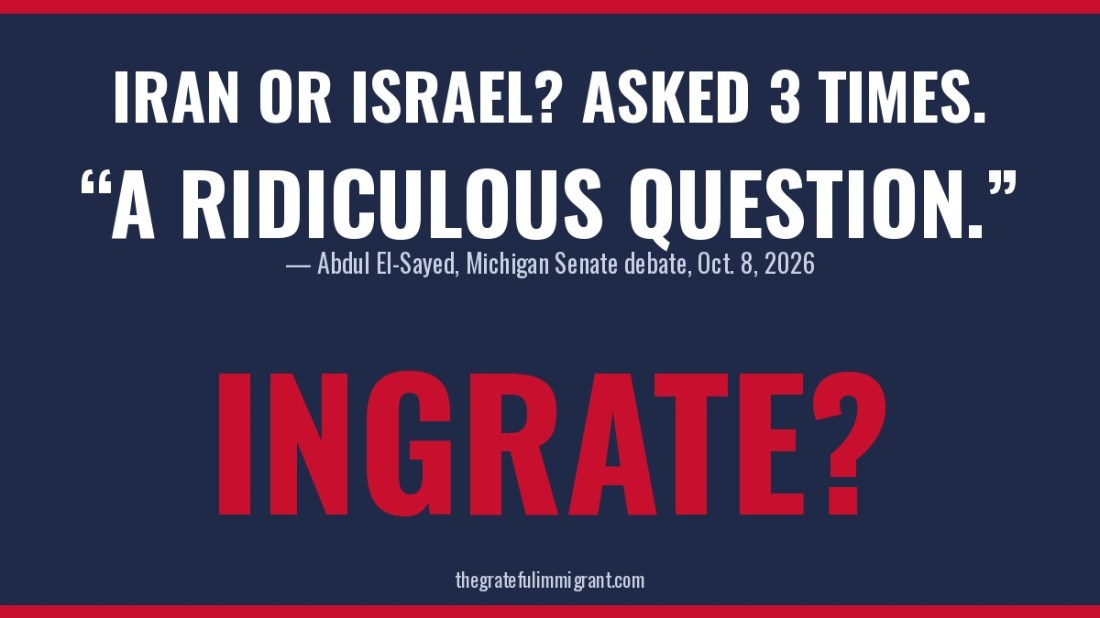
Michigan: “A ridiculous question.”
Abdul El-Sayed, Democratic nominee for U.S. Senate, debated Republican Mike Rogers at WOOD TV8 in Grand Rapids. [1][2]
El-Sayed was born in Rochester Hills, Michigan, and raised by his father, an Egyptian immigrant. University of Michigan. Rhodes Scholar at Oxford. Medical degree from Columbia. [15][16]
Moderator Rick Albin asked him which country is the greater threat to the United States, Israel or Iran. [3]
El-Sayed: “I’m just going to say that that’s a ridiculous hypothetical.” [3]
Albin: “I’ll ask one last time. Israel or Iran?” [4]
El-Sayed: “That’s, again, a ridiculous question. I think both of them have proven dangerous in their own way.” [3][4]
He also said Israel “has pushed us to go to war in Iran.” [3]
Iran held 52 Americans hostage for 444 days. [5] The Pentagon says Iran-backed militants killed at least 603 U.S. personnel in Iraq. [6]
He called the question ridiculous.
New York: plain answers.
Same night. NY1 and Spectrum News. Republican Saritha Komatireddy, running for New York Attorney General, debated incumbent Letitia James. [7][8]
Komatireddy was born in Brooklyn. In her own words: “My parents actually came to New York in the 1980s and settled down in Coney Island. It’s where they did their medical training at Coney Island Hospital.” Her family moved around the country; she grew up in Missouri and came back to New York to be a federal prosecutor. [9][10] Her parents are doctors who immigrated from Telangana, India. [11]
Harvard Law. Federal prosecutor in Brooklyn for more than a decade. Chief of staff at the DEA under President Biden. [12][10]
On antisemitism, she didn’t hedge. Of James: “This is the problem. She just stands there. She doesn’t do anything.” [7]
On Jewish students: James “has used it for other students but not for Jewish students who have been barricaded in libraries because of their race got no help from Tish James.” [7]
And when James was asked whether she supports a standard definition of antisemitism? “We are looking at the definition of antisemitism.” [8][13]
Looking.
Komatireddy’s campaign promise, in writing: “On Day One of my administration, I will declare a state of emergency over antisemitism.” [14]
On law and order: “I’m running for New York attorney general to make sure that New York is safe to prosecute crime, prosecute fraud, and take the homeless off the streets.” [12]
Now, honesty. Komatireddy was not asked Israel or Iran. Published coverage shows no Middle East question in that debate. [8] So I won’t put words in her mouth.
What I can judge is what each one did with the question in front of them.
One answered. One called it ridiculous.
It’s not about ancestry.
Both are children of immigrants. Both were born here. Both are accomplished: Oxford and Columbia medicine on one side, Harvard Law on the other.
So this isn’t about blood. We judge conduct.
One looked at America’s enemies and America’s friends and wouldn’t pick.
The other looked at Jewish New Yorkers being attacked and said: I will prosecute.
That’s the difference between gratitude and grievance.
If anyone has evidence that I’ve got either of them wrong, show me. I’ll look at it.
Coddling is as pernicious as laziness.
We’ve spent years telling newcomers and their kids they don’t have to choose. Keep the old grudges. Keep the old enemies. America will make room.
That’s coddling. And coddling rots a people the same way laziness does.
Gratitude is the opposite.
Gratitude is spine. It’s agency. America makes its own decisions; nobody “pushes” us. And a grateful citizen stands up and says so, out loud, even when it costs votes.
The Three A’s.
Accountability. Answer the question you were asked. El-Sayed didn’t. Komatireddy did.
Assimilation. Take on this country’s values. Equal protection means Jewish students get it too.
Allegiance. When someone asks who threatens America, you answer for America. First time.
That’s stewardship. We didn’t build this house. We inherited it. Our job is to guard it, for the ones who come after.
Same night. Two children of immigrants. Two answers.
You decide.
Grateful, or Ungrateful?
Spine, not knees.
LIVE GRATEFUL.
P.S. Update on our first Ungrateful: another American-born son of Turkish parents.
Hasan Piker was born in New Brunswick, New Jersey, to Turkish parents. [18]
He streamed the Michigan debate live. Thursday night, October 8. [17]
That same night, Jon Ossoff debated Mike Collins for a Senate seat in Georgia. [20] Komatireddy debated Letitia James in New York. [8]
Of all the debates that night, Piker chose that one to livestream.
Piker doesn’t live in Michigan. He lives in Los Angeles. He bought a $2.74 million house there in 2021. He can’t vote in that race. [21]
My read: he wanted to showcase the most obvious ungrateful child of immigrants, and shove it in our faces, to keep the narrative going.
When El-Sayed called the Israel-or-Iran question “ridiculous” for the second time, here’s what Piker said at his screen:
“Say America, say Michigan. Say America, say Michigan.” [17]
El-Sayed didn’t.
A few moments later he added: “No, just say, just say, I don’t care about either of these countries. I care about America. I’m an American.” Then: “No, not America, the biggest threat. Just like, turn it back to like, I don’t care about either of those countries, I’m American. America number one.” [17]
Hasan Piker. The man who said America deserved 9/11. [19]
Here’s my read, and it’s mine.
He led with “Say America.” The question on the table was who the bigger threat is, and the first word out of his mouth is America. That’s what his audience hears: America is the threat.
Then he covered it. “No, not America, the biggest threat.” “America number one.” Fake patriotism, laid on after the message landed.
That’s the pattern with Piker. He knows what he wants his audience to hear. Then he obfuscates.
Don’t take my word for it. The clip is linked below. Watch it and judge for yourself.
And here’s the thing. It would have been an easy one.
“Iran is the bigger threat.”
That’s an answer. And it still leaves Israel as a threat, if that’s what he believes. People can parse it all day long.
If a follow-up came, his qualifiers about Israel’s actions would land with his voters. And his opponents would get it. They’d disagree, but they’d get it.
He couldn’t even do that.
That’s the whole question of stewardship in one night. Whose side are you on? If you can’t say Iran is the threat, then you’ve picked a side, and it’s not America.
If anyone has evidence I’ve read it wrong, show me.
Sources
- WOOD TV8, full debate video, Oct. 8, 2026. https://www.woodtv.com/video/michigan-u-s-senate-candidates-abdul-el-sayed-and-mike-rogers-debate-at-wood-tv8/12250853/
- Detroit Free Press, Oct. 8, 2026. https://www.freep.com/story/news/politics/elections/2026/10/08/abdul-el-sayed-mike-rogers-us-senate-debate/92162055007/
- The Jerusalem Post, “El-Sayed says Israel, Iran have both proven ‘dangerous’ to US.” https://www.jpost.com/international/article-911134
- JNS, “In Michigan Senate debate, El-Sayed won’t say Iran worse than Israel…” https://www.jns.org/news/u-s-news/in-michigan-senate-debate-el-sayed-declines-to-say-iran-worse-than-israel
- National Archives, “444 Days: Selected Records Concerning the Iran Hostage Crisis 1979-1981.” https://www.archives.gov/research/foreign-policy/iran-hostage-crisis
- Military Times, “Iran killed more US troops in Iraq than previously known, Pentagon says,” April 4, 2019. https://www.militarytimes.com/news/your-military/2019/04/04/iran-killed-more-us-troops-in-iraq-than-previously-known-pentagon-says/
- New York Post, Oct. 9, 2026. https://nypost.com/2026/10/09/us-news/letitia-jamess-gop-opponent-for-attorney-general-saritha-komatireddy-trounces-in-fiery-ny-ag-debate/
- VINnews, Oct. 9, 2026. https://vinnews.com/2026/10/09/komatireddy-challenges-letitia-james-on-crime-antisemitism-and-fraud-in-heated-debate/
- Saritha Komatireddy, podcast interview, June 30, 2026 (transcript). https://exa.ai/library/podcast/bv66dz9l8z5/episode/x1s0ndr80sr
- Hindustan Times, “Who is Saritha Komatireddy?” https://www.hindustantimes.com/world-news/us-news/who-is-saritha-komatireddy-all-about-her-family-net-worth-as-president-donald-trump-endorses-letitia-james-opponent-101786849190133.html
- The Vetting Room, May 4, 2020. https://vettingroom.org/2020/05/04/saritha-komatireddy/
- Spectrum News NY1, Aug. 5, 2026. https://ny1.com/nyc/all-boroughs/news/2026/08/05/republican-saritha-komatireddy-lays-out-record-in-challenge-to-ag-letitia-james
- Matzav.com, debate coverage, Oct. 2026. https://matzav.com/fiery-showdown-letitia-james-grilled-by-gop-challenger-over-antisemitism-crime-medicaid-fraud-and-trump-prosecutions/
- Komatireddy campaign release, “Komatireddy pledges ‘state of emergency’ on antisemitism.” https://sarithafornewyork.com/komatireddy-pledges-state-of-emergency-on-antisemitism-vows-ag-takeover-of-prosecutions-where-district-attorneys-fail-to-protect-new-yorkers/
- Bridge Michigan, “Who is Abdul El-Sayed?” https://bridgemi.com/michigan-government/who-is-abdul-el-sayed-what-to-know-about-michigan-democrats-us-senate-winner/
- El-Sayed campaign, About. https://abdulforsenate.com/about/
- Hasan Piker’s livestream coverage of the Oct. 8 Michigan Senate debate, posted on X by @socialistadri, Oct. 8, 2026 (Israel-or-Iran segment at about 29:49–32:00; quotes at about 31:30–32:12). https://x.com/socialistadri/status/2108358316821024941
- Wikipedia, “Hasan Piker” (born July 25, 1991, New Brunswick, N.J., to Turkish parents). https://en.wikipedia.org/wiki/Hasan_Piker ; IBTimes UK. https://www.ibtimes.co.uk/who-hasan-piker-quick-facts-handsome-64-twitch-streamer-whos-been-accused-animal-cruelty-1747107
- Washington Examiner, on Piker’s 2019 “America deserved 9/11” remark, which he has since walked back. https://www.washingtonexaminer.com/news/entertainment/4756365/hasan-piker-says-far-less-damaging-9-11-comment-trump-iran-take-out-california/
- Atlanta News First, “Sen. Jon Ossoff, Rep. Mike Collins meet in first Georgia Senate debate,” Oct. 8, 2026. https://www.atlantanewsfirst.com/2026/10/08/live-tonight-sen-jon-ossoff-faces-rep-mike-collins-first-statewide-senate-debate/
- Business Insider, “Hasan Piker faces criticism for buying a nearly $3 million home in Los Angeles County,” Aug. 23, 2021. https://www.businessinsider.com/hasan-piker-house-twitch-streamer-criticized-los-angeles-2021-8