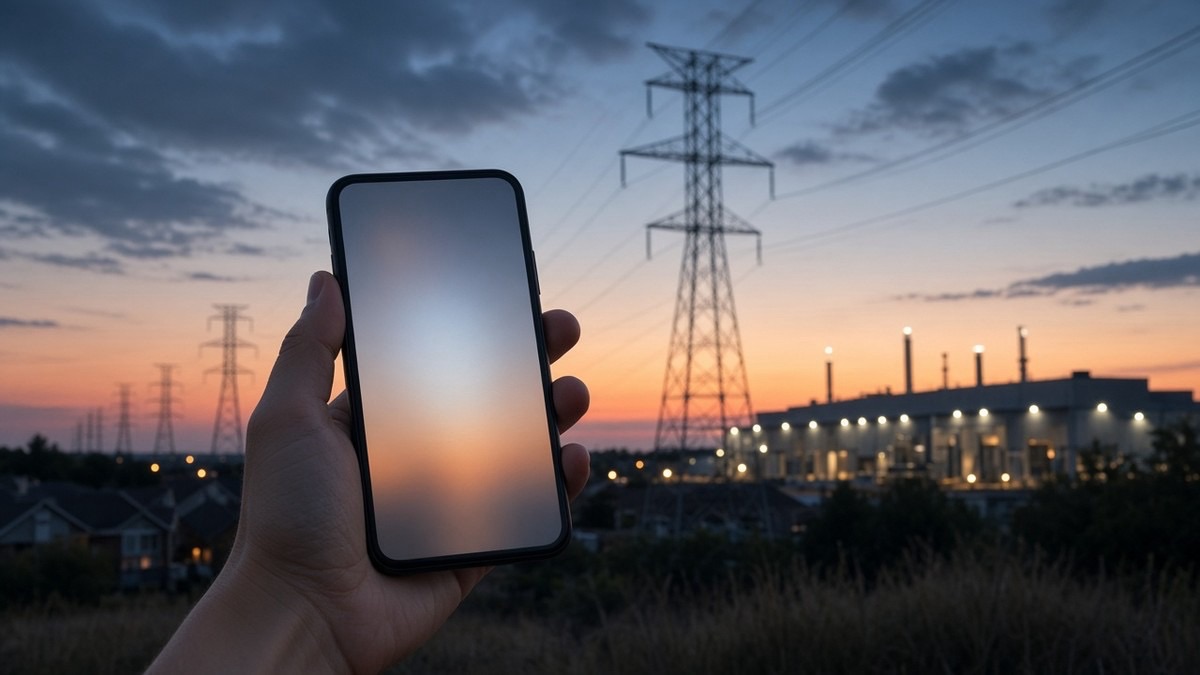
I, like all of you, know what pays the bills.
It’s not speeches. It’s the light bill. Food. Whether people already living here get stuck paying for someone else’s project.
You’re on your phone. Or your laptop. Or whatever device you have right now.
You scroll. Or you ask a direct question. Maps. Bank. School. Clinic. Work. Dinner. A dumb thing at midnight.
However you do it — you are asking.
That is the accepted fact. We all ask. Billions of us. Business and personal. Every day.
When the information is not already on your device, it has to be held and processed somewhere else. That is what data centers do. Power. Cooling. Buildings. People. It does not run on air.
There is a cost to everything.
That cost is covered in countless arrangements by all of us — ads, subscriptions, enterprise contracts, taxes, prices baked into other products, and sometimes a quieter line on the power bill. Everybody pays. Somehow.
Simply put: who pays?
Better: how do we pay — since we all ask?
Let me ask you straight.
Every time you ask — do you pay cash for that one answer? Right there. You okay with that?
No. Most of us are not.
Fine. Then the people who hold and process the answers still have to cover their costs — and still make a profit. That is the incentive. Without it, why build the plants, the lines, the buildings?
So how do they pass the cost?
Direct pay-per-ask is a hard no for most people. Nobody wants a charge every time they search.
What is really happening is sponsors, subscriptions, ads, free tiers that are not free, monthly fees, big contracts. Layers.
Now the news is talking about direct costs on the grid — power plants, transmission, capacity charges showing up on household bills. Is that better than ads? Better than subscriptions?
That is the fight. Not a cartoon of good versus evil. The messy middle — where we live.
We — consumers and providers — want something for nothing. Free answers. Instant access. Fat margins. No ugly line on the bill.
The need to hold and process data this way is here to stay. Phones are not going back. Neither is the demand for answers that live off-device. Pretending otherwise is fantasy.
People have the incentive to provide the infrastructure. Jobs. Tax base. National competition. Profit. That incentive is real and it is not going away.
There are always inherent risks. Projects get delayed. Demand gets overbuilt. Costs get shifted onto people who never signed the deal. Rules get written soft so the transfer stays quiet. Politicians sell intent — “protect ratepayers,” “unleash innovation” — because intent is the easy sell. The hard part is the arrangement.
So the adult question is not “should we ask?” We will ask.
The adult question is: how do we cover the costs, keep the incentive to build, mitigate the risks, and still survive failure?
That is what Congress is arguing about right now. Doesn’t that make sense?
The bill on the table
September 16, 2026. The House passes the Ratepayer Protection Act — bipartisan, 417 to 3. Plain idea: if a giant user — a data center pulling 100 megawatts or more — needs new plants, lines, and upgrades, that user should cover the full cost of serving them. Not your kitchen. Not the shop on Main Street.
States would have to consider that standard. It is not a magic federal switch. Florida, Oregon, Virginia, Texas, Alabama, Nebraska, South Dakota are already moving their own ways to make big loads pay their way.
September 17. The Senate stalls it. One objection: too soft, too voluntary. Midterms are weeks away. Voters are mad about power bills. Washington does a show. The meter still runs.
Same fight. Same fact. Everybody pays somehow. The bill is one attempt to keep the pass-through honest — so the people who need the megawatts own those megawatts, and the incentive to build does not become a quiet tax on households.
What hits your life
I do not need a think-tank chart for this. If Amazon, Microsoft, Google, Meta, and the builders need a power plant the size of a town, somebody writes the check — and if the rules are soft, that somebody is often you.
PJM — the big grid from Illinois to Virginia and D.C., tens of millions of people — has seen capacity prices explode. The market monitor ties a huge share of that jump to data-center demand. In places like Ohio and western Maryland, people are looking at roughly sixteen to eighteen dollars a month extra on the capacity piece alone. Pepco customers in D.C. already saw jumps. Mississippi customers have been told Amazon-related infrastructure cost them about ten dollars a month. Maryland advocates say ratepayers are on the hook for billions in transmission that mainly serves Virginia data centers.
That is the light switch. That is not pay-per-search. That is cost moving into a bill you did not negotiate when you typed the question.
Risk, in plain words: if the arrangement is soft, failure and overbuild do not stay with the company. They land on you.
Both sides — still the same question
Yes, build. America should not lose this race by sleeping. Jobs. Tax base. Real tools. The need is here to stay. Providers need a profit. Incentive. Otherwise why do it?
Yes, cover costs with eyes open. Ads. Subscriptions. Contracts you can read. Rate rules that make large users pay for the upgrades they trigger. That keeps the incentive without pretending “free” was free.
Hiding the same cost in a household power bill while we all keep asking — that is not negotiation. That is a transfer.
Industry groups now say they support paying full freight for grid upgrades they cause. Good. Put it in the rate order. Put it in the contract. Put exit fees on the table when a project shrinks and leaves stranded steel. Talk is cheap. A rule you can read is how you mitigate risk.
Wasteful build should not get a blank check because the logo is fashionable. Bad architecture is still a cost someone pays.
So which is better — reported grid costs, or ads and subscriptions?
Neither gets a clean cheer. Both are how we already pay. The fight is which pass-through is honest, which keeps the incentive, and which leaves you holding the bag when something fails.
What stewardship looks like here
Remember the three A’s lightly.
Accountability: the company that needs the megawatts owns those megawatts — not a silent ratepayer who never agreed to the deal.
Assimilation: joining this country’s bill-paying culture means no special carve-out because the product is “AI.”
Allegiance: stewardship of the house includes the grid. Bright lines. No free riders. Survive failure without dumping it on the neighbor by default.
I am not anti-build. I am anti-transfer. Anti-lying about the check.
A helping hand for real industry? Yes. A permanent open tab from every household to a campus of servers while we keep scrolling like the answer was free? Heck no.
We want something for nothing. Consumers. Providers. Politicians with a sermon. That hunger is easy.
The adult work is harder: cover the costs, keep the incentive, mitigate the risks, survive failure — since we all ask, and everybody pays. Somehow.
If the answer is “everybody, quietly,” with no name on the line — that is not progress. That is another hit on the kitchen table.
If the answer is everybody pays, somehow, with eyes open — that is still a cost. It is also honesty. And honesty is how a free people lasts.
It starts in the spine, not on your knees.
LIVE GRATEFUL 🇺🇸
– A Grateful Immigrant

 Grateful Immigrant