Think about your own brain. Everything you’ve ever thought, written, seen, or heard lives in there — some of it you remember, some of it you don’t. When you need to process something, you recall it. That data is already in your head.
But when you don’t remember it, or you’ve never learned it, you have to go outside. You ask someone, you look it up, you run an experiment. And then you have to trust that the outside information is accurate before you can process it.
That’s exactly what a data center is. Your phone is the brain. The data center is the outside world you go to when your brain doesn’t have the answer.
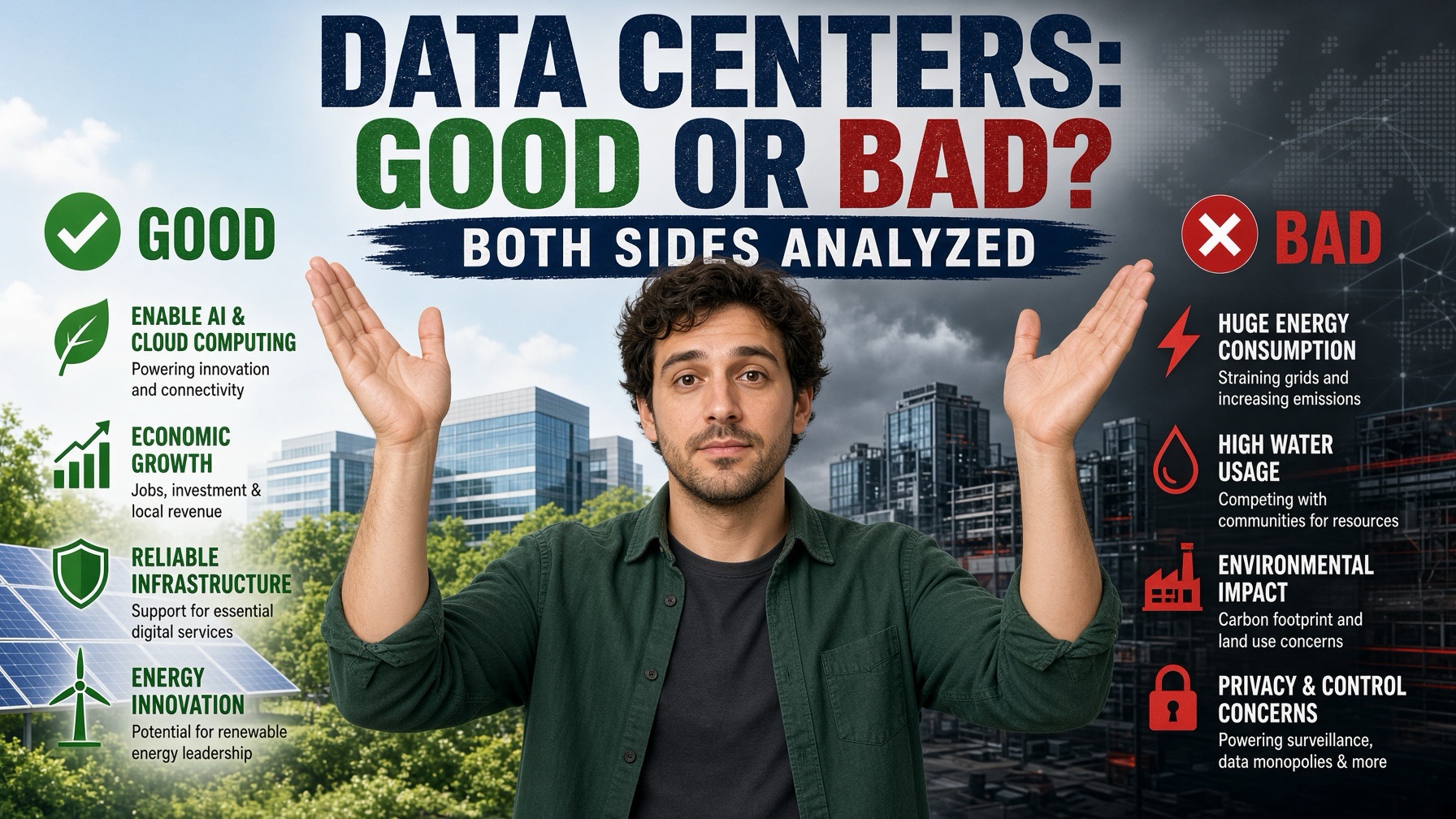
The “Yes” side — Amazon, Microsoft, Google, Oracle, and the investors behind them. Their argument: AI needs massive buildings full of servers, and America has to build them fast or China wins. They point to real numbers — the US holds most of the world’s AI infrastructure, and private investment runs over twenty times China’s. National security, they say. Jobs and tax revenue, they add.
The “No” side — Jay Valentine, VP of Operations at Fractal Computing, and the communities fighting the buildout. Their argument: the hyperscale model is obsolete technology from fifty years ago. Valentine claims their software kills the bottleneck that makes data centers necessary. He says workloads that eat a data center for ninety-two hours now run in nine minutes on an Apple Mini. His pitch: America already has a thousand times the compute it needs, and the hyperscale push is a false choice pushed by people who profit from it.
Both sides are telling the truth. Both sides are leaving out the part that costs them.
The hyperscalers are right that two billion people wanting compute at once needs somewhere to land. Valentine is right that hauling data across a continent to a CPU is wasteful architecture built for a different era.
The honest position isn’t picking a side. It’s accepting the tension: data has to live somewhere, somebody has to maintain it, and no architecture deletes that fact. Local-first, cloud-when-needed, copies so one failure doesn’t erase the record. That’s not a solution. It’s a survivable trade-off.
Custody is just who holds the keys. Think of a library. The books have to live somewhere — a building, a shelf, a person watching the door. If the librarian loses the key, the books are gone. If the librarian is careless, the books get damaged. Custody means somebody is responsible for keeping the information safe, and that somebody has to be awake at three in the morning when something breaks.
Failure survival is what happens when the librarian drops the key anyway. You don’t put all the copies in one room. You make copies — three copies, on two different shelves, one of them in a different building. If one shelf catches fire, the other copies survive. That’s redundancy.
But here’s the part the distributors miss. The library never closes — new books arrive every day, from eight billion people thinking eight billion different thoughts. You can’t just hand out what’s already on the shelf. Someone has to keep receiving, sorting, and shelving the new ones too.
Custody isn’t a one-time job. It’s a job that never ends.
And that job has a shape. New information first has to land somewhere. Then it gets distributed as a second step. Then it gets maintained — again and again, over and over. Land, distribute, maintain. Then a new book arrives and you start over.
That’s the loop, and it never stops. The mistake is thinking any one of those three steps is the hard part. They’re all hard, and they all repeat forever.
Perfect custody is a fantasy. Make failure survivable instead.
LIVE GRATEFUL 🇺🇸
(It starts in The Spine NOT on your Knees.)
– A Grateful Immigrant

 Grateful Immigrant