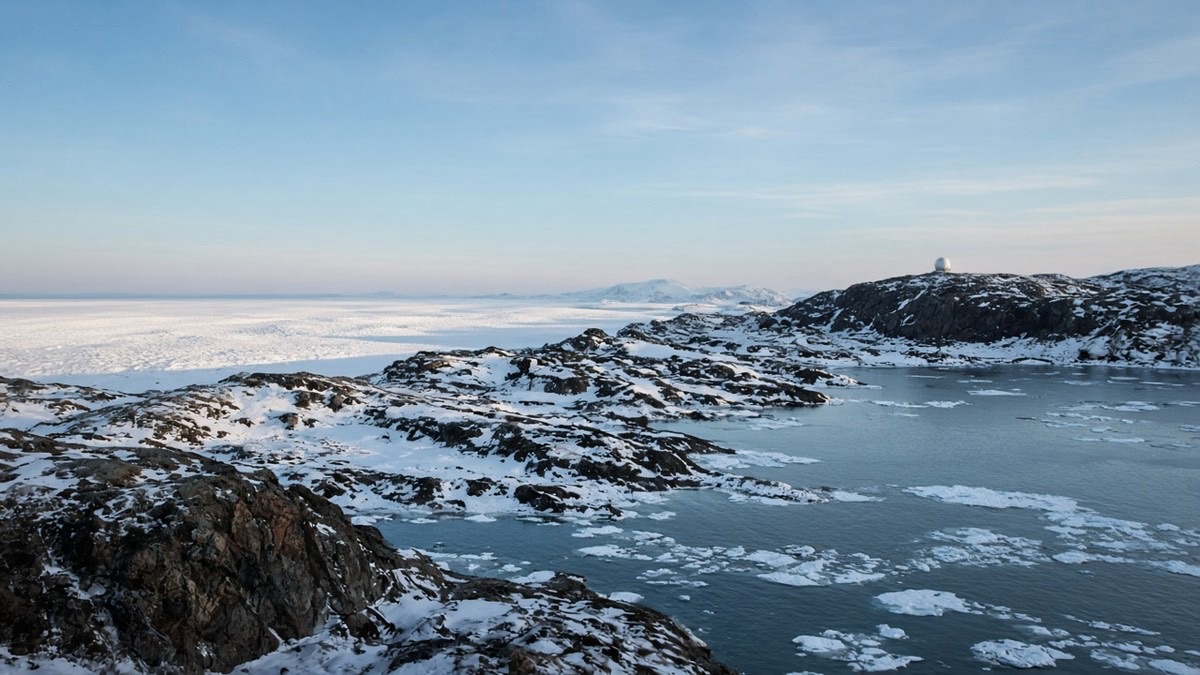
This week the United States, Denmark, and Greenland said they have a three-party security deal on Greenland. Signing is expected next week at the UN. The full text is not public. Danish and Greenlandic parliaments still have to approve it. So nobody should pretend the paperwork is already settled.
Trump’s bluster got them to the table.
That is not a compliment and it is not an insult. It is a description. Months of “take Greenland,” “control Greenland,” ownership talk, NATO nerves — pressure. Denmark and Greenland did not want a sale. Washington wanted locked-in security and a hard line against adversary footholds. The table is where those forces met.
What happens at the table is yet to be seen. Words on Truth Social and words from Copenhagen are both sales. The adult test is the signed text: who decides bases, who decides “sensitive” money, what survives an independence vote, and what “permanent” actually means when someone says no.
What we know so far
Three parties: United States, Denmark, Greenland.
Claimed shape: expanded U.S. security role in the Arctic and North Atlantic; bar U.S. adversaries from bases, troops, or sensitive investments without U.S. written approval; U.S. says “no cost” and “infinite life.” Denmark and Greenland say sovereignty of the Kingdom stands, and Greenlanders keep the right to self-determination.
This is not annexation. Not “Greenland becomes America.” The U.S. already had serious rights under the 1951 defense setup with Denmark, including Pituffik Space Base. What is new — if the text matches the talk — is Greenland as a named party, a thicker permanent frame, and a clearer veto on China/Russia-style footholds and “sensitive” projects.
Minerals, rare earths, Arctic shipping, missile and space warning — that is why grown countries care. Location is not a slogan. Location is a fact.
Of course China, Russia, and the rest on the opposite side of America are also planning how to handle this. They are not confused. They read maps. They read minerals. They read who can park ships and who can dig. When Washington locks something down, they adjust. That is not a conspiracy. That is how rivals behave.
Deterrence is not a fantasy
Here is the part soft people skip.
The world is run by the aggressive use of force — or at least by the threat of it. Deterrence. Bases. Fleets. Treaties with teeth. The ability to say not here and mean it.
The fantasy is thinking or hoping it isn’t.
You can dislike that. You can wish for a world of pure negotiation and good intentions. Wish all you want. Borders still need enforcement. Alliances still need someone willing to show up with more than a press release. The Arctic still needs someone who can deny it to a hostile power.
Trump’s loud talk was ugly diplomacy. It was also a reminder that polite silence does not move capitals when the prize is ice, minerals, and a flank of the North Atlantic. Denmark and Greenland answered with red lines: no sale, sovereignty language, self-determination. The U.S. answered with permanence language: security control, adversary ban, stay forever. Both sides are speaking the language of power. One side calls it “control.” The other calls it “shared security.” The table is where those words get priced.
Who still calculates survival
The major powers I have named — America, China, Russia, and the allied systems around them — still have self-preservation in mind. They can be ruthless. They can be wrong. They can cheat. They still calculate: loss, gain, escalation, face, survival of the regime and the state. Deterrence works on people who want to keep living and keep ruling.
I could not say that for the Islamists.
Not “every Muslim.” Not your neighbor who works and pays taxes and keeps the house. Islamists — the ones who treat politics as holy war, who treat civilians as fair game, who treat the state’s survival as less important than the cause. Self-preservation of a shared civic order is not their operating system. Martyrdom logic, caliphate logic, humiliation-and-revenge logic — that is a different machine. You do not deter it the same way you deter a capital that wants to stay on the map.
That difference matters when you talk about Greenland, about NATO, about borders, about who gets to invest “sensitively” next to your flank. Major-power rivalry is ugly and real. Ideological death cults are also real. Pretending they are the same kind of “stakeholder” is how soft countries get surprised.
Both sides — still adult
Yes, lock the Arctic. America should not sleep while rivals hunt bases and minerals on the roof of the world. Incentive to hold the line is stewardship at scale — Allegiance that is more than a flag emoji.
Yes, read the text. “Permanent control” without paper is speech. Sovereignty language without enforcement is also speech. Accountability means names on the clauses. Assimilation into an alliance means shared burden, not shared fantasy that force never decides outcomes.
I am not for buying peoples. I am not for pretending the map is a charity. A helping hand among allies? Yes. A permanent habit of lying about power? Heck no.
We want something for nothing in foreign policy too — safety with no steel, alliances with no cost, Arctic security with no ugly words. That hunger is easy.
The adult work is harder: get rivals to the table, write the deal, keep the incentive to defend, mitigate the risk of overreach, and survive failure when someone tests the line — because the world still runs on force and the threat of it, and everybody pays somehow when that truth is ignored.
It starts in the spine, not on your knees.
LIVE GRATEFUL 🇺🇸
– A Grateful Immigrant

 Grateful Immigrant