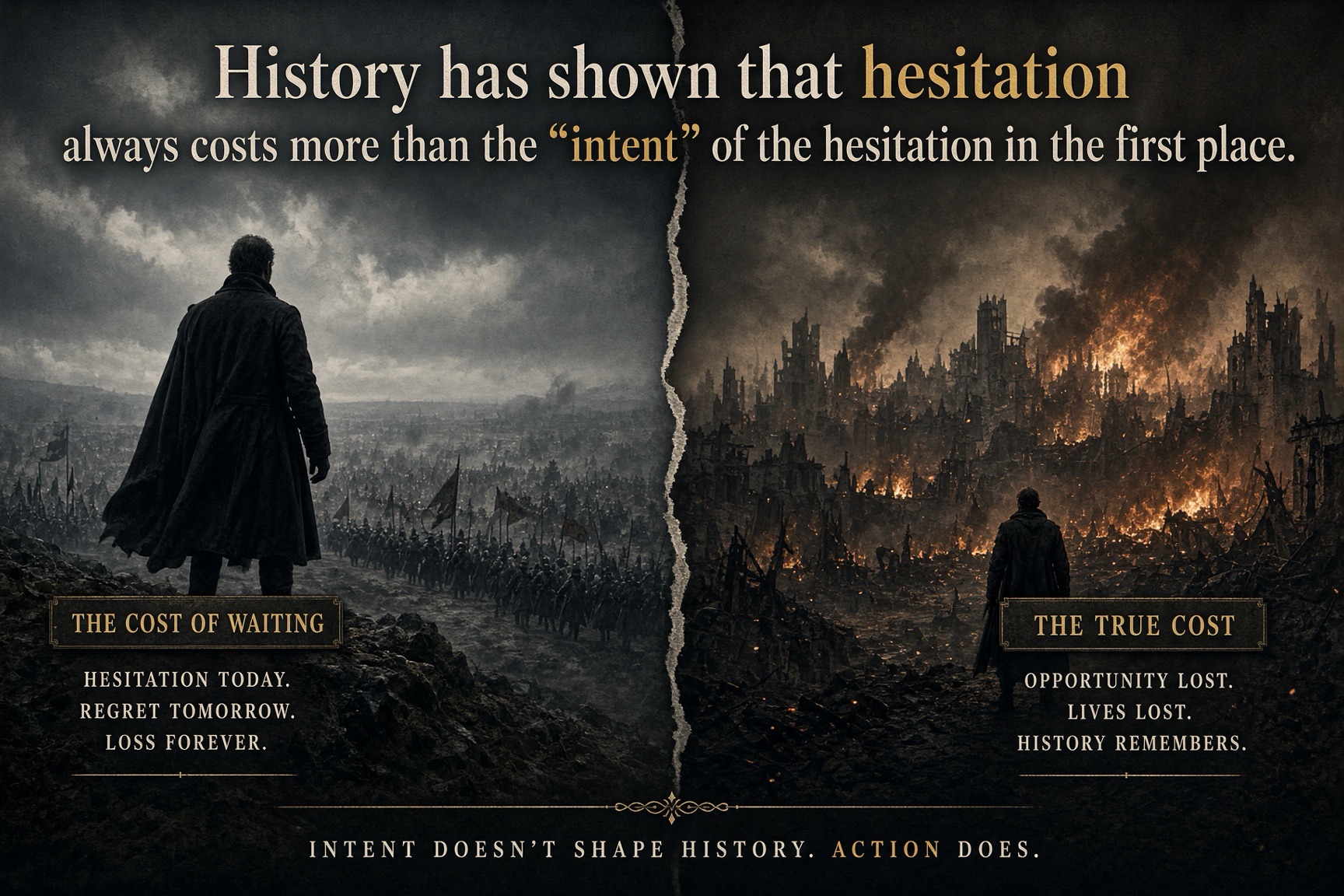
There’s something especially bitter about watching regular people—soldiers and civilians alike—pay the compounded price for earlier hesitation.
A threat that could have been met with clearer force and fewer lives later ends up demanding more blood, more money, and more disruption because the decisive moment was deferred. The intended savings of restraint evaporate. The actual cost arrives with interest.
This is not theory. It is a pattern. Ideological enemies do not improve with time and partial measures. They use the pause to rebuild, recruit, harden, and test how much weakness they can extract. Material benefits—jobs, trade, coexistence, reconstruction money—are treated as temporary concessions or as proof that the other side lacks the will to finish the job. Negotiation is often read as blinking. The longer the cycle of calibrated strikes, temporary deals, and managed tension continues, the higher the eventual bill for the ordinary people who will have to settle it.
October 7 made the dynamic plain. Livelihoods provided, medical access offered, neighborly contact that existed for years—none of it restrained the bloodlust when the opportunity came. Those “bargaining chips” were discarded. Attempts to treat them as leverage were irrelevant to people for whom the destruction of the other was itself the point.
The same logic applies wherever an ideology defines the opponent as illegitimate by existence. Half-measures and perpetual management do not buy peace. They buy time for the threat to grow more expensive to confront.
Accountability requires facing this reality instead of comforting ourselves with the language of endless process. Allegiance requires protecting the ordered liberty we inherited rather than transferring the hard choices to the next generation. Assimilation into the American way means rejecting the soft delusion that every conflict can be managed into disappearance if we just stay polite long enough.
The pacifist or “manage it indefinitely” posture often fails its own stated goal. It does not minimize suffering. It shifts the suffering onto a later, bloodier phase and onto people who had no vote in the earlier decisions.
That is the part that is truly sad—and predictable.
Accountability. Assimilation. Allegiance.
Practiced permanently, prudently, pragmatically.
LIVE GRATEFUL 🇺🇸
(It starts in The Spine NOT on your Knees.)
— A Grateful Immigrant


