Stewardship Analysis: Which Ideology Supports and Defends Agency

The Real Contest Between the Two Dominant Ideologies in America

Agency is not a soft word.
It is the hard core of human dignity.

Agency means:
I am responsible for my choices.
I can fail and still rise.
I am not first a member of a group; I am first a free individual.
My future is not primarily determined by systems, history, or other people’s sins. It is determined by what I do with the hand I am dealt.

That single idea — individual agency — is the load-bearing wall of a free republic. Remove it, and everything else eventually collapses into dependence, resentment, and control.

The stewardship question is therefore sharp:

Which of the two main ideologies in America today supports and defends agency — and which systematically weakens and replaces it?

And the second question flows directly from the first:

Which ideology protects the individual from the group’s moral superiority police — the ones who cancel you when you refuse to surrender your agency to their narrative?

Because times have changed.
Earlier generations warned us about people imposing their morality on the free individual. Tocqueville saw the soft despotism of majority opinion. Mill warned against the “moral coercion of public opinion.” The Founders feared factions that would crush liberty under the banner of virtue.

Those warnings were not wrong.
They were incomplete for our age.

Today the coercion rarely arrives first with a badge. It arrives with a hashtag, a workplace DEI tribunal, a campus mob, a corporate blacklist, a social media pile-on. If the individual refuses to bow to the group’s latest sacred morality — on race, sex, borders, climate, history, or speech — the group cancels. Careers end. Reputations burn. Friends vanish. The message is clear: surrender your independent judgment or be destroyed.

This is not liberation.
This is a new Puritanism with rainbow flags and equity spreadsheets.

So let’s do the stewardship analysis without hedging.

The Two Ideologies

Ideology A: The Ideology of Agency
(Founding American tradition, classical liberalism, conservative realism, meritocracy, free-market individualism)

Core claim: The individual is sovereign. Character is forged under pressure. Success is earned through voluntary effort, delayed gratification, and resilience. The nation thrives when free people keep what they earn and are free to fail and rise again. Equality before the law. Freedom of conscience and speech. Group identities are secondary to individual rights and personal responsibility. Agency is not optional — it is the engine of everything good.

Ideology B: The Ideology of Equity
(Progressive collectivism, identity politics, neo-Marxist-inflected “social justice,” woke managerialism)

Core claim: Outcomes must be equalized by group. “Systems” and historical “oppression” explain most disparity. Individual failure is often evidence of structural injustice rather than personal shortfall. Speech and thought that challenge the group narrative are violence. Safety (emotional, identity-based) overrides open inquiry. The enlightened group has the moral right — indeed the duty — to police language, hiring, curriculum, and culture until equity is achieved. Agency that produces unequal outcomes is treated as a problem to be managed.

Test 1: Which ideology supports and defends agency as the source of long-term success for the individual and the nation?

Ideology A: Fully. Without apology.

It treats agency as sacred.
Falling is information. Struggle is the forge. Rising is expected.
When a man owns his failures, he owns his future. When a nation rewards those who exercise agency rather than those who demand the obstacle be removed by force, it produces inventors, builders, soldiers, entrepreneurs, and parents who raise the entire floor for everyone else.

Long-term success for the individual: competence, self-respect, wealth creation, family stability, and the quiet pride of having earned one’s place.
Long-term success for the nation: economic dynamism, cultural confidence, military strength, and the only cohesion that lasts — voluntary allegiance built on shared achievement, not enforced guilt or group preference.

This is why certain groups — Asian Americans, Nigerian immigrants, West Indian Blacks, Jews after centuries of persecution, and every wave of grateful immigrants who arrived ready to work — have repeatedly outperformed the prevailing narratives. Patterns of agency beat patterns of grievance. Every single time.

Ideology B: It weakens agency and then pretends to protect the weak.

It reframes personal struggle as proof the system is rigged.
It labels resilience “internalized oppression” or “respectability politics.”
It teaches that real power comes from extracting concessions rather than producing value.
Safe spaces, trigger warnings, grade inflation, DEI set-asides, and the endless hunt for external villains all send the same message: your agency is secondary to your group status. If your group is deemed oppressed, your lack of results is someone else’s fault. If your group is deemed privileged, your success is suspect.

The result is predictable and measurable:
Fragile individuals. Declining competence. Rising resentment. A nation that cannot compete with cultures that still treat agency as non-negotiable.
China does not teach its students that the exam is rigged because of historical grievances. They teach them to work harder. We used to know this.

Stewardship score on this test:
Ideology A: 10/10
Ideology B: 2/10

Test 2: Which ideology protects the individual from the group tyranny of the moral superiority police?

Ideology A: Yes — by design.

It built the classical liberal firewall: free speech is not free speech only for the approved. The individual has rights against the majority, against the state, and against the mob. Conscience is not subject to a vote. You may be wrong. You may be unpopular. You may be called every name in the book. But the state and the culture (at its best) are not supposed to destroy you for thinking heretical thoughts.

It remembers Tocqueville and Mill. It remembers that yesterday’s moral majority became today’s minority, and that the only reliable protection is principle, not which tribe currently holds the microphone.

This is why the same people who defend free speech for the Christian baker also defend it for the atheist, the immigrant who criticizes open borders, and the professor who questions the latest orthodoxy. The principle is the protection of agency itself.

Ideology B: No. It is the current face of the moral superiority police.

It has inverted the old warning.
The group that claims the highest moral status now claims the right to define truth, punish heresy, and demand ritual confessions. Disagreement is not debate; it is “harm.” Dissent is not protected speech; it is “violence.” Refusal to use preferred language or affirm preferred history is a firing offense in universities, corporations, media, and government.

The historical pattern is ancient: every revolutionary moral elite eventually becomes the new Inquisition. The only difference today is the language of compassion and the tools of HR departments and algorithmic amplification.

This is why you can lose your job for noticing crime statistics, for defending women’s sports, for saying a man cannot become a woman, for criticizing DEI, or for simply refusing to kneel. The group decides what is moral. The individual who will not surrender his independent judgment is cancelled.

Stewardship score on this test:
Ideology A: 9/10
Ideology B: 1/10

The Stewardship Verdict

Only one ideology can steward a free republic for the long haul.

The Ideology of Agency supports and defends the free individual as the basic unit of moral and political life. It treats people as capable of rising. It protects the smallest minority — the individual — from the group that claims the right to cancel him for non-compliance.

The Ideology of Equity softens the individual until he cannot stand on his own, then replaces the old moral police with a new one that is more efficient, more total, and more self-righteous.

Gratitude demands we choose clearly.

I did not come to this country in 1987 to trade one set of imposed group moralities for another. I came for the chance to exercise agency — to work, to fail, to rise, to speak freely, and to be left free to do it without a committee of the enlightened deciding whether my thoughts were allowed.

That is the American deal.
That is the only deal that produces both free people and a strong nation.

Accountability. Assimilation. Allegiance.
Practiced permanently, prudently, pragmatically.

Defend agency.
Protect the individual from the group that claims the right to cancel him for non-compliance.

Anything less is not stewardship.
It is surrender.

LIVE GRATEFUL 🇺🇸
(It starts in The Spine NOT on your Knees.)

– A Grateful Immigrant
Cottage Grove, Minnesota


This Is the Greatest Republic the World Has Ever Seen — A Grateful Immigrant’s Reflection on America’s 250th

Friends,

Last night at Mount Rushmore, President Trump said it plain: This is the Greatest Republic the world has ever seen. Nothing even comes close.

He was right. And on this 250th anniversary of our Independence, I say the same thing without hesitation or false humility — as a Proud American who chose this country with my eyes wide open.

I arrived to permanently live in the United States in 1987. It came after a 15-year wait for our family’s immigration petition to be approved. Fifteen years of paperwork, patience, and hope. When the approval finally came, I didn’t step off the plane with demands or grievances. I came with nothing but grit and a willingness to become American — fully.

That gratitude has only grown deeper over the decades. I’ve traveled every state in this Union, raised a family, paid my taxes, sworn the oath of citizenship in 1992 with full conviction, and built a life I could never have imagined in the place I left behind. This nation gave me opportunity, order, and a future worth fighting for.

But my concern for her — for us — has grown right alongside that gratitude.

This republic was not an accident. It was forged from the best of Western civilization — the principles that flowed from Athens, Jerusalem, and Rome, through the British tradition, and into a new American character on this continent. A nation where rights come from the Creator, not from government. Where the people are sovereign. Where voluntary exchange and relentless agency produced more human flourishing than any system in history.

I didn’t come here to remake America in the image of the place I left. I came to join the American political family — to assimilate into its language, its culture, its values, and to give it my full allegiance. That is how immigration works when it strengthens a nation instead of straining it. Accountability. Assimilation. Allegiance. Practiced permanently, prudently, and pragmatically.

Too many today want the benefits without the burden of belonging. They want the fruits of this republic while refusing to plant their loyalty in its soil. We see it in the cheapening of citizenship, in the refusal to enforce the borders that define a sovereign people, and in the quiet (and sometimes loud) rejection of the very culture that made this the greatest republic on earth.

On this 250th birthday, we celebrate what was built — but we must also look honestly at what is required to keep it.

This republic does not run on autopilot. It demands a spine. It starts in the spine, not on our knees. It demands that those who come here do what I was prepared to do in 1987: wait if necessary, respect the process, learn the language, embrace the culture, and swear allegiance without reservation or divided loyalty.

It demands that those of us already here — native-born and naturalized alike — teach our children the real story of this nation, not the guilt-soaked caricature being pushed in too many classrooms. It demands leaders who lead from strength, not from the appearance of begging. And it demands that every one of us who loves this country act like we intend to keep it.

I am not here by accident. None of us who chose America deliberately are. We are the living proof that this republic still works — when we do our part.

So on this July 4th, 2026, I celebrate without apology. I celebrate the 56 men who signed their names to a declaration that shook the world. I celebrate the generations who defended it, expanded it, and corrected its flaws without tearing down its foundation. And I celebrate every legal immigrant who arrived the right way, did the hard work of assimilation, and became a grateful, contributing American.

This is still the Greatest Republic the world has ever seen.

But she will only remain so if we — all of us — live like we believe it.

LIVE GRATEFUL 🇺🇸

– A Grateful American

The Grateful Immigrant’s Take: “Forever Wars”? No — Good vs. Evil IS Forever

Many good, hard-working American citizens — veterans, taxpayers, moms and dads who’ve buried sons and daughters, and everyday folks just trying to keep the lights on — are exhausted. They look at our country’s military engagements overseas and say, “Enough. No more forever wars.”

I hear them. I respect their fatigue. They’ve watched trillions of dollars vanish into sand, seen flag-draped coffins come home, and wondered why America keeps bleeding while our own borders stay wide open and our cities crumble. Their frustration is real. Their desire for peace at home is honorable. As a legal immigrant who arrived with nothing in 1987 and swore allegiance to this flag in 1992, I understand the longing for a nation that puts its own people first.

But here’s where we must be honest. The phrase they keep repeating — “forever wars” — deserves a closer look.

What “Forever Wars” Really Means

The term “forever wars” (or “endless wars”) exploded in popularity after 9/11. It describes the long, grinding fights in Afghanistan, Iraq, Syria, Yemen, and beyond — operations that stretched for decades with no clear victory parades, no defined finish lines, and no obvious benefit to the average American family. Critics on both the right and the left use it to argue:

  • These conflicts cost too much in blood and treasure.
  • They create more enemies than they kill.
  • They enrich defense contractors while draining the heartland.
  • America should just come home and stay home.

Presidents from both parties have promised to end them. Candidates still campaign on it. And millions of citizens nod along, tired of what feels like permanent entanglement.

I get the slogan. It’s catchy. It feels like common sense.

But slogans are not truth. And this one misses the deeper reality.

This Grateful Immigrant’s Take — Step by Step

Step 1: Good and Evil do not take vacations. Evil is not a temporary policy problem you can “end” with a tweet or a withdrawal date. Evil is ancient, relentless, and patient. It wears new masks — communism yesterday, theocratic terror today — but its goal never changes: to enslave the free, to crush the grateful, and to replace light with darkness. The moment you pretend evil can be negotiated away or ignored until it “goes away,” you have already lost.

Step 2: America did not choose this fight — Evil chose us. On 9/11, radical Islamists did not attack us because we were in their backyard. They attacked us because we exist as a free, grateful, God-blessed nation. The same is true of Iran’s regime today. They chant “Death to America” not because we occupy them, but because our very existence as a shining city on a hill exposes their tyranny. You don’t end that by leaving the field. You end it by standing firm.

Step 3: “Forever wars” is the wrong diagnosis. The real problem has never been that America stayed too long. The real problem is that America often fought with one hand tied behind its back — nation-building instead of decisive victory, political correctness instead of raw strength, half-measures instead of total commitment. When we fight to win — quickly, prudently, and without apology — the wars are short. When we fight to manage or appease, they become “forever.”

Step 4: Good vs. Evil IS forever. This is the part polite society doesn’t want to say out loud. The battle between Good and Evil did not start in 2001 and will not end tomorrow. It is the permanent condition of a fallen world. From Cain and Abel to the American Revolution to the fight against Iran’s death cult, free men and women have always had to choose: stand and fight with gratitude and spine, or retreat and watch evil grow.

That choice never expires.

Step 5: True allegiance demands permanent, prudent, pragmatic action. This is where my three pillars come in.

  • Accountability: We must hold evil regimes accountable — no more excuses, no more pallets of cash, no more “strategic patience.”
  • Assimilation: America’s enemies must assimilate to civilized norms or be removed. They do not get to import their theocracies or ideologies here.
  • Allegiance: Every grateful citizen — immigrant or native-born — owes permanent loyalty to the country that gave us freedom. That loyalty is not negotiable when evil knocks.

Practiced permanently, prudently, and pragmatically — that is how a grateful nation stays free.

Step 6: Authority is not the issue — Moral clarity is. We can argue semantics about carrying out the battle: timing, resources, strategy, prudence. But make no mistake—we are the good ones. There is no moral equivalence here. Moral equivalence is a tool used to hamper us, to create false symmetry between defenders of liberty and those who sponsor terror, hang dissidents, stone women, fund proxies to murder innocents, and vow our destruction. Equating America’s reluctant but necessary defense with the evil of Iran’s theocracy is not wisdom—it’s surrender disguised as sophistication.

For the crowd quick to cry “Where’s your congressional authority?” or “This violates the Constitution,” let’s set the record straight: The President operates under Article II as Commander-in-Chief, with inherent power to defend the nation and its interests against imminent threats. This authority is as old as the Republic—no full declaration of war required for every defensive or limited action.

The War Powers Resolution of 1973 (passed post-Vietnam to check endless entanglements) requires notification to Congress within 48 hours and a 60-day clock (plus 30-day withdrawal) unless Congress authorizes or declares war. Yet presidents of both parties have relied on Article II for swift, decisive strikes without prior approval—because evil doesn’t wait for hearings.

  • Obama ordered the 2011 Libya intervention without upfront congressional authorization, citing Article II and national interests. He expanded drone strikes across Yemen, Somalia, Pakistan—hundreds without new votes.
  • Recent administrations used Article II (and stretched 2001/2002 AUMFs) for strikes against Iran-backed militias.
  • These aren’t anomalies—they’re precedent. Limited, prudent actions to neutralize threats fulfill the oath to protect and defend.

The selective outrage over “authority” often aims to paralyze our side while excusing inaction. When the President acts to eliminate a regime’s nuclear ambitions or command structure plotting against Americans and allies (as in the recent decisive operations against Iran’s theocracy that eliminated the Supreme Leader), it’s not overreach—it’s duty.

No moral equivalence. We are the good ones. True gratitude means acknowledging our power, right, and duty to act decisively when evil forces our hand.

Final Word from a Grateful Immigrant

So when you hear “forever wars,” remember this: The war against Evil is indeed forever. The only question is whether America will fight it with the same grateful, unapologetic spirit that built this nation—or whether we will tire, retreat, and hand the future to the forces of darkness.

I chose allegiance in 1992. I choose it still. I will never apologize for wanting the Good to win—permanently.

What about you, fellow American?

Are you ready to stop calling it “forever wars”… and start calling it what it really is?

The eternal fight between Good and Evil.

And as long as there is breath in this grateful immigrant’s body, I will stand on the side of Good—with spine, with gratitude, and with total allegiance to the greatest nation on earth.

God bless America. And may He give us the wisdom and courage to finish what Evil started.

MetricScore (0–10)Quick Reason
Accountability8Accepting Responsibility
Assimilation7NA
Allegiance8Protecting Citizens
Permanently8Acted for future security
Prudently8Acted with ALL available info
Pragmatically8Took what was available
Total47/60Verdict: Mixed

Because of President Trumps’ actions on Iran, my scorecard for my country improved from 45 out of 60 to 47/60.

– The Grateful Immigrant from St. Paul, Minnesota

LIVE GRATEFUL 🇺🇸 (It starts in The Spine NOT on your Knees)

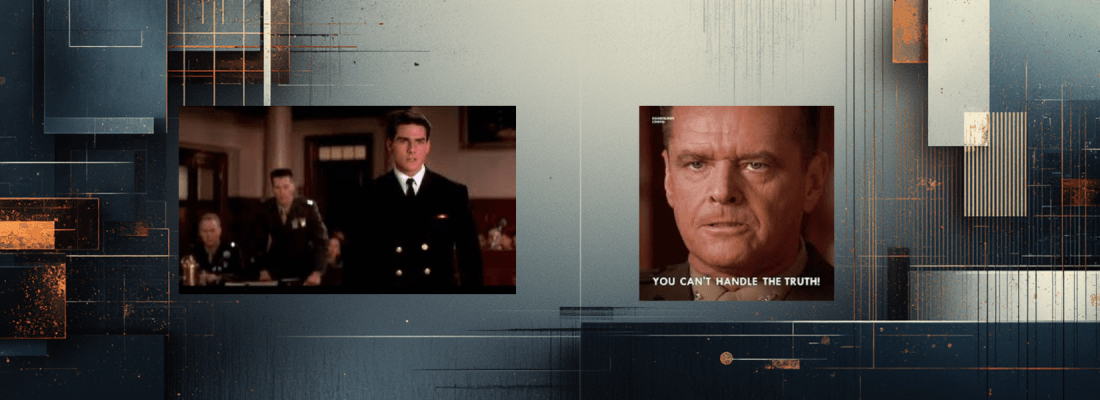
You Can’t Handle The Truth!

Sometimes we borrow lines because they say what we can’t.

Start with Rocky Balboa — old, beat-up, facing his son who’s bitter, resenting the name, the weight. The kid wants excuses. The dad doesn’t give ’em. He just looks him dead in the eye:

“It ain’t about how hard you hit. It’s about how hard you can get hit and keep moving forward. How much you can take and keep moving forward. That’s how winning is done.”

That’s the truth. No apology. No guilt. Just grit.

And the kid? He takes it. Doesn’t swing back. Doesn’t run. He stands there… then starts walking. Because he finally heard it: life doesn’t care if you’re ready. It hits. You either move or you break.

Now go back to A Few Good Men. Tom Cruise—Colonel McCaffrey—pushes Jessup: “I want the truth!”

Jessup leans in, voice like steel:

You can’t handle the truth!”

Then he unloads—full blast:

“Son, we live in a world that has walls. And those walls have to be guarded by men with guns. Who’s gonna do it? You? You, Lieutenant Weinberg? I have a greater responsibility than you can possibly fathom. You weep for Santiago and you curse the Marines. You have that luxury. You have the luxury of not knowing what I know: that Santiago’s death, while tragic, probably saved lives. And my existence, while grotesque and incomprehensible to you, saves lives. You don’t want the truth. Because deep down, in places you don’t talk about at parties, you want me on that wall. You need me on that wall. We use words like honor, code, loyalty… we use these words as the backbone to a life spent defending something. You use ’em as a punchline. I have neither the time nor the inclination to explain myself to a man who rises and sleeps under the blanket of the very freedom I provide, then questions the manner in which I provide it! I’d rather you just said thank you and went on your way. Otherwise, I suggest you pick up a weapon and stand a post. Either way, I don’t give a damn what you think you’re entitled to!”

They wrote it to crucify him. Instead, it became gospel. Because we all know: most of us can’t handle the truth.

We want the walls. We want the freedom. We just don’t want the bill.

So yeah — your thread? Same thing. Stop apologizing. Stop flinching.

Because the truth hurts.

But you’re gonna have to take it.

– The Grateful Immigrant from St. Paul, Minnesota

February 18, 2026

LIVE GRATEFUL 🇺🇸

Grateful Borders: Who Gets to Join America’s Order in the Mess?

Look around: People from every corner of the globe—every color, creed, race, or religion—are drawn to America like moths to a flame. Legal or illegal, the migration speaks volumes. It’s not just about freedom (that’s secondary); it’s the economic opportunity that pulls them in. But pause for a second: Has anyone dug deep into why this happens? Not with fluffy progressive slogans, but with the hard truth?

America didn’t become the beacon by accident. It’s the result of a deliberate life of gratitude, built on three unshakeable pillars—personal accountability, cultural assimilation into our Judeo-Western values, and fierce allegiance to the Constitution and its symbols. Practiced with the three Ps: Permanent (not fleeting trends), Prudent (wise and measured), and Pragmatic (real-world results over ideals). This isn’t feel-good talk; it’s the “Order in the Mess” I’ve unpacked in my series (if you haven’t read them yet, start there—they’re the foundation).

My thesis? This grateful framework is why America has outshone every nation or empire in history. No other place offers such scalable success because no other place demands and rewards this mindset so consistently. And that’s exactly why immigration policy matters: It’s our chance to extend this order, not dilute it.

So, for citizens and legal immigrants alike, let’s ask the open questions pragmatically:

  • Who should be able to immigrate? Those who embody or commit to our pillars—folks ready to take personal accountability for their journey, assimilate into our values (not impose theirs), and pledge true allegiance. Think skilled contributors like Elon Musk or Satya Nadella, who turned gratitude into innovation. Not those seeking handouts or shortcuts, which erode the very opportunity that drew them.
  • How? Through legal, vetted pathways that mirror prudent order: Applications, background checks, affidavits of support, and integration requirements (like English proficiency or civics tests). Make it permanent by tying green cards to demonstrated assimilation, not just time served.
  • How many? Enough to fuel growth without overwhelming our systems—say, 1-1.5 million annually, based on economic needs and assimilation capacity. Pragmatic caps prevent the mess of unchecked influx, preserving gratitude’s fruits for all.
  • How implemented? Congress sets the rules, the executive (via DHS and USCIS) handles the process—streamlined digitally for efficiency, with a focus on merit over lotteries.
  • Who’s to enforce? Agencies like CBP and ICE, prioritizing threats while rewarding compliance. Enforcement isn’t cruelty; it’s prudence, ensuring the system stays trustworthy.

This isn’t about walls for walls’ sake—it’s about grateful stewardship. By tying immigration to our pillars and Ps, we turn potential chaos into harmonious order, just like nature does. America thrives when immigrants arrive not as takers, but as grateful builders. Live grateful, stand firm, and let’s keep the beacon shining.

(Table: Applying the Pillars to Immigration – for a quick visual summary)

PillarApplication to ImmigrationWhy It Matters
Personal AccountabilityRequire proof of self-sufficiency and no criminal historyEnsures newcomers contribute, not burden
Cultural AssimilationMandate values alignment and integration programsPreserves Judeo-Western foundation for unity
Allegiance to ConstitutionOath of loyalty with enforcement for violationsBuilds permanent trust and shared success

If this sparks thoughts, drop a comment below or share on X @Grateful1776US. Stay grateful!

– The Grateful Immigrant from St. Paul, Minnesota

February 15, 2026

LIVE GRATEFUL 🇺🇸

Modern Chaos & the Pillars in Action – Seeing the Patterns Today

(Order in the Mess Series – Observations)

We’ve traced order from nothing to creatures, families to the Founding, and landed on three pillars for everyday life. But what does it look like when the chaos feels louder than ever?

Look around Saint Paul right now—division, protests, political shouting matches, people questioning the basics (borders, laws, trust in institutions). It’s not new. The 1787 delegates faced states acting like rival countries, rebellions over debt, foreign powers poking at weaknesses. Today’s mess echoes that: groups pushing for forced changes (open borders without assimilation, rewriting rules for power grabs), ignoring natural limits and voluntary choice.

Victor Davis Hanson recently reminded us on The Daily Signal: Japan’s Pearl Harbor attack wasn’t U.S. provocation—it was imperial ambition for resources and dominance. A classic forced assortment move: take what you want, force others in, pay the price later. History repeats when we forget the pattern—forced blending breeds conflict; voluntary bonds with limits last longer.

The pillars cut through it:

  • Accountability: Demand leaders and neighbors play by the same rules. Call out hypocrisy (sanctuary policies while ignoring legal immigrants who assimilate). Fix the structure—vote, speak up, hold elections accountable.
  • Assimilation: Own your place. Work hard, learn the ways, contribute. Immigrants who thrive here do this daily—adding value instead of demanding the system bend.
  • Allegiance: Protect what works. Teach kids why liberty and self-reliance matter. Support communities that build instead of tear down. It’s not blind loyalty—it’s defending the setup that lets regular people raise families and pursue dreams.

Chaos feels overwhelming, but it’s not the end. Patterns are still there: autonomy seeking, chosen bonds, natural limits. The Founding gave us a way to work with them. The pillars are your daily tools—one choice at a time.

Even in the noise.

— The Grateful Immigrant from Saint Paul, Minnesota

February 14,2026

LIVE GRATEFUL 🇺🇸